How Can Automated Account Reconciliation Scale with Business Growth?
Kosh.ai
February 13, 2026
For any growing business, the finance department is the silent engine that keeps everything running. But as a company expands—adding new customers, opening bank accounts, and processing more transactions—that engine can start to sputter. One area where this strain is felt most acutely is account reconciliation: the tedious but critical process of matching your internal financial records against bank statements, credit card statements, and other external data to ensure everything is correct.
For years, this process has been a manual nightmare of spreadsheets, paper statements, and long hours during month-end close. But what happens when you’re processing millions of transactions instead of thousands? The manual approach simply breaks. This is where technology steps in.
The global reconciliation software market is projected to grow from USD 2.65 billion in 2026 to USD 8.10 billion by 2034, growing at a steady compound annual growth rate (CAGR) of 15.00% . This explosive growth isn't just a trend; it's a response to a fundamental business need: the ability to scale financial operations without proportionally scaling headcount or risk.
In this article, we’ll explore exactly how automated account reconciliation acts as a growth multiplier for your business. We’ll look at the pain points of manual processes, the mechanics of automation, and the tangible ROI that allows your finance team to become a strategic asset rather than a cost center.
Understanding the Scalability Challenge in Financial Reconciliation
Before we dive into the solution, it’s crucial to understand why reconciliation becomes a major bottleneck during growth. Scalability is about handling increased workload without a drop in performance. In finance, this is incredibly difficult to achieve manually.
The Hidden Costs of Manual Reconciliation in a Growing Company
When a business is small, a founder or a part-time bookkeeper can handle reconciliation in a few hours using Excel. It’s manageable. However, consider a mid-sized company scaling rapidly. Suddenly, the finance team is drowning in data.
According to recent data, a startling 49% of finance departments still operate with zero automation, relying entirely on manual data entry and spreadsheets to close their books . This reliance creates several growth-stifling problems:
- Time Consumption: As transaction volumes grow, so does the time spent on data entry. A task that took 5 hours a month can balloon to 50 hours. This forces teams to work overtime or forces companies to hire more staff just to keep up with compliance, rather than focusing on strategic analysis.
- Higher Error Rates: Humans are not machines. When tired or rushed, we make mistakes. A single misplaced decimal or a duplicated entry in a spreadsheet can lead to inaccurate financial statements, poor business decisions, and compliance headaches.
- Fraud and Security Risks: Manual processes often lack oversight. Without a centralized system with audit trails, it becomes easier for fraudulent transactions to slip through the cracks or for data to be manipulated. The increasing volume of data fraud, particularly in financial services where customer fraud accounts for 44% of economic crime, makes automated oversight non-negotiable .
- Delayed Decision Making: If your books aren't closed until the 15th of the following month (or later), you are making business decisions on stale data. In a fast-paced market, this is a competitive disadvantage. You can't manage cash flow effectively if you don't have a real-time view of it.
When Spreadsheets Become a Liability
Excel is a fantastic tool, but it is not a database, nor is it a proper internal control system. In a growing company, spreadsheets lead to "file hell"—multiple versions of the same reconciliation file floating around via email, making it impossible to know which version is correct. There is no audit trail, no enforced approval workflow, and a high risk of broken formulas. Spreadsheets simply cannot provide the governance or efficiency required as a business scales, making automated bank reconciliation software a necessary upgrade.
What is Automated Account Reconciliation?
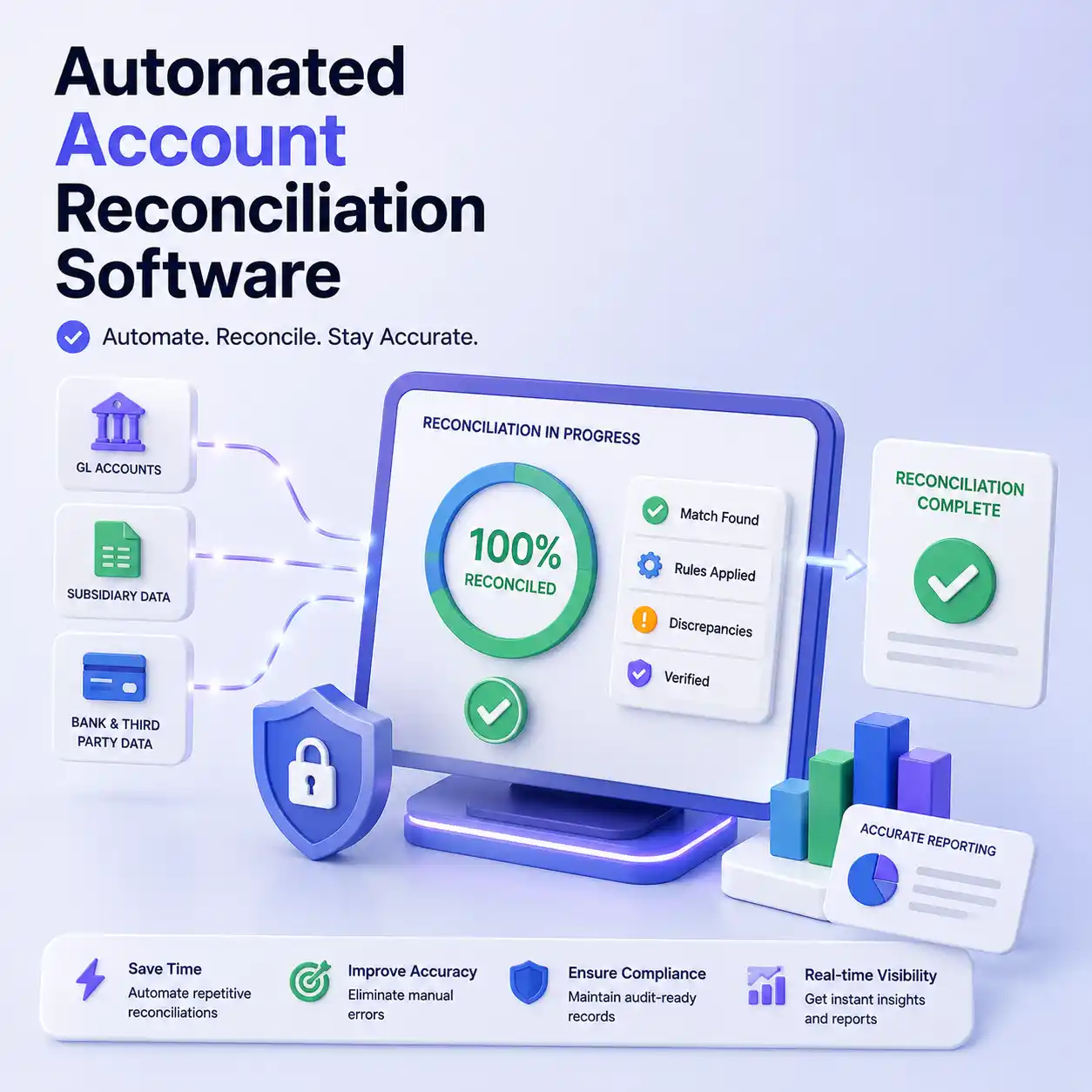
At its core, automated account reconciliation is the use of reconciliation automation tools to replace manual checks with software-driven processes. It automatically compares financial data from different sources—like your Enterprise Resource Planning (ERP) system and your bank—to ensure they match.
How Automation Transforms the Three-Way Match
Reconciliation isn't always just one-to-one. Often, it involves a three-way match, particularly in accounts payable and receivable. This involves matching the purchase order, the goods receipt note, and the supplier invoice.
Automation tools use predefined business rules to perform this match in seconds. For instance, accounts reconciliation software can instantly flag an invoice where the price doesn't match the purchase order. This allows staff to focus only on the exceptions (the "needles") rather than verifying every single transaction (the "haystack").
Core Features of a Scalable Reconciliation Solution
Not all software is created equal. A solution built to scale with your business typically includes:
- Automated Data Import: It pulls data directly from bank feeds, ERP systems, and other sources via API, eliminating manual downloads.
- Rule-Based Matching: You set the rules (e.g., "match if transaction amount and date are identical"), and the software automatically clears those items.
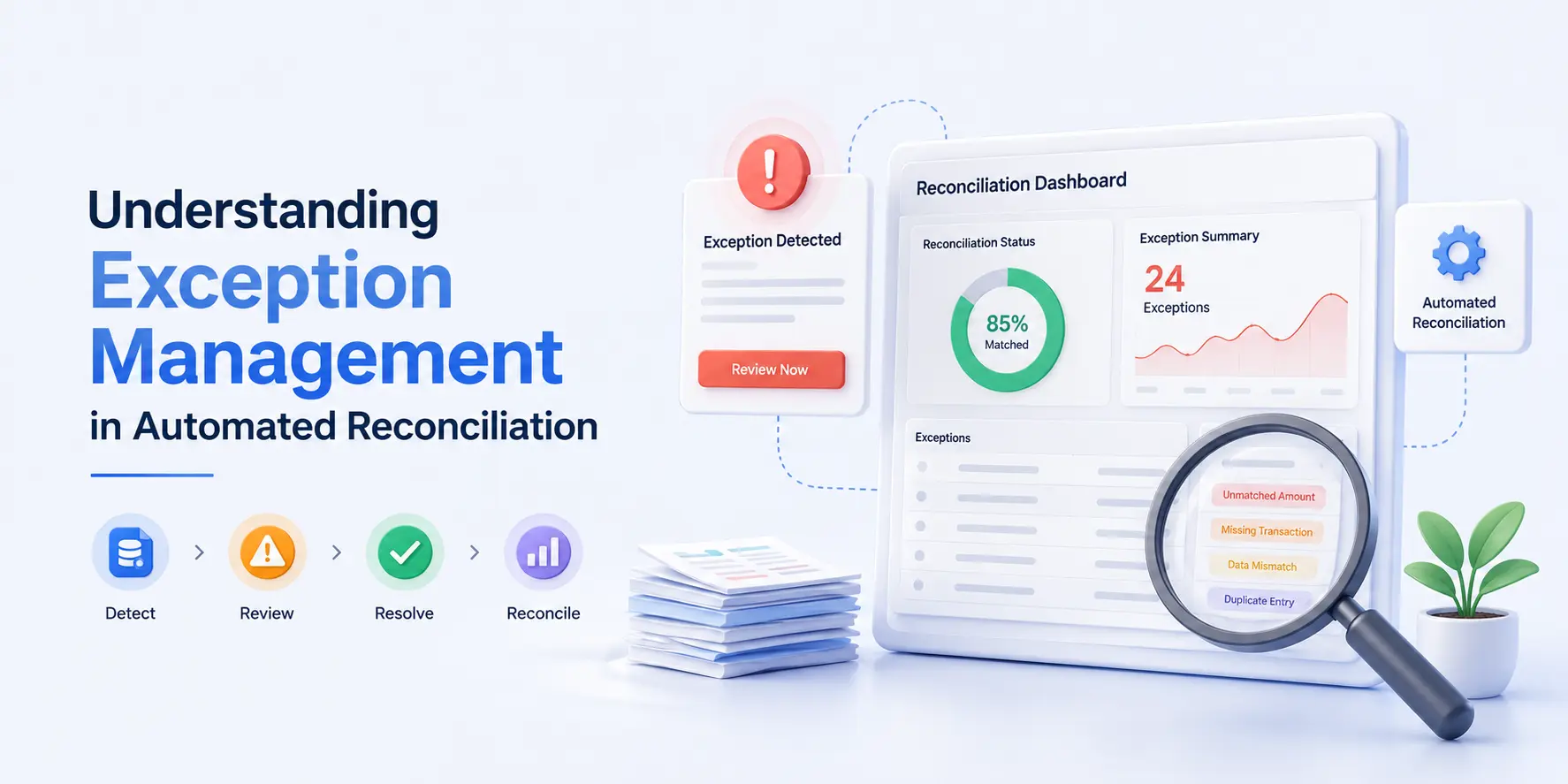
- Exception Handling: The system flags only the transactions that don't match the rules, creating a workflow for investigation.
- Approval Workflows and Audit Trails: Reconciliations are routed to the right people for approval, and every action is timestamped and logged, making audits painless.
- Real-Time Dashboards: Management can see the status of the balance sheet reconciliation software process at any moment, not just at month-end.
The Direct Link: How Automation Fuels Business Growth
Investing in reconciliation automation is not just about cutting costs; it's about enabling growth. Here is the direct line of sight between automated reconciliation and your ability to scale.
Handling Increased Transaction Volume Without Hiring Sprees
Imagine a retail company experiencing a boom in online sales. Their transaction volume doubles overnight. With a manual system, the finance team would be immediately underwater. They would have to work nights and weekends, and the company would likely need to hire temporary or permanent staff to clear the backlog. This is a reactive, costly approach.
With an automated reconciliation system, volume becomes just a number. The software doesn't get tired. Whether it's processing 10,000 transactions or 10 million, the cost of processing that marginal transaction drops to nearly zero. For example, a financial risk management division overseeing $170 billion in assets implemented an automated solution and achieved a 75% time savings, drastically reducing the time spent on manual data entry . This allows existing teams to absorb higher volumes without the need for rapid, expensive hiring.
Accelerating the Financial Close: From Weeks to Days
The speed of the financial close is a key metric for any CFO. It measures how quickly they can get an accurate picture of the company's financial health. Manual reconciliation is the biggest bottleneck in the close process.
Automation compresses this timeline dramatically. A leading dental service organization, Affordable Care, which reconciles over 600 bank accounts monthly, found that certain ledger tasks that took over 36 hours each month now take less than one business day after implementing automation . By shrinking the close cycle from weeks to days—or even hours—business leaders can make faster, more informed decisions to capitalize on market opportunities.
Improving Accuracy and Auditability
Growth brings scrutiny. Whether from investors, board members, or regulators like the IRS, larger companies face more audits. Manual spreadsheets are an auditor's worst nightmare. They are difficult to verify and easy to manipulate.
Automation provides a "source of truth." Bank reconciliation automation creates a clear, immutable audit trail. It shows who did what, when, and why. This transparency builds trust with stakeholders. Moreover, by reducing manual intervention, you drastically cut down on human error. Instead of guessing, you have hard data. The integration of AI and machine learning has enhanced this further, allowing software to detect anomalies and flag potential fraud in real-time, moving from reactive to proactive financial management .
Real-World Proof: Case Studies in Scalable Reconciliation
Numbers on a page are compelling, but real-world examples bring the power of automated reconciliation to life. Here are two scenarios that demonstrate the scalability factor.
Case Study 1: Affordable Care – From 36 Hours to One Day
Affordable Care, the largest dental service organization in the US, faced a monumental task. They had to reconcile over 600 bank accounts every month. Their legacy tools and manual processes were buckling under the pressure. They needed a reconciliation solution for banks and internal accounts that could handle high volume and was easy to use.
After implementing a dedicated solution, they processed over 4 million transactions and achieved a staggering 90% match rate . The impact was immediate. The time spent on specific ledger tasks plummeted from 36 hours to under one business day. This freed up the team's time and allowed them to focus on investigating the remaining 10% of exceptions. As their manager put it, the software "blows away the hay and leaves you with the needles," allowing the team to focus on what truly matters. This is the essence of scaling: doing more work (4 million transactions) in significantly less time.
Case Study 2: Risk Management Division – 75% Time Savings
Consider a US-based financial risk management division responsible for $170 billion in assets . They were receiving data from 16 different counterparties in various formats, leading to a labor-intensive, error-prone manual process. They knew that as trading volumes increased, this process would become a crisis.
They implemented a flexible, automated platform with a no-code environment, allowing their team to adapt to new requirements without IT help. The results were remarkable:
- 75% time savings on manual data entry and validation.
- Full ROI achieved in just six months.
- Exponentially increased operational capacity to handle high-volume trading without adding headcount .
This case study perfectly illustrates the definition of scalability: the capacity to handle growth without increasing resources. The automated bank reconciliation allowed them to scale operations exponentially while keeping costs and headcount flat.
Key Features to Look for in Scalable Reconciliation Software
If you're convinced that automation is the path forward, the next step is choosing the right tool. But with so many options, from simple accounting tools to enterprise-grade platforms, what should you look for to ensure it can scale with you?
Cloud-Based Architecture and API Integrations
First and foremost, the software must be cloud-based. On-premise software requires you to manage your own servers and IT infrastructure, which becomes a bottleneck during growth. Cloud solutions, like software for bank reconciliation, are maintained by the vendor and can be updated instantly.
More importantly, look for robust API integrations. Your reconciliation tool needs to talk to your bank, your ERP (like NetSuite or SAP), your payment processors, and your CRM. Seamless integration via APIs ensures that data flows in real-time without manual file exports and uploads, providing a single source of truth .
AI-Powered Matching and Intelligent Exception Handling
Basic rule-based matching is a good start, but true scalability comes from intelligence. Reconciliation automation tools are increasingly leveraging AI to handle fuzzy logic. For example, an AI-powered tool can learn that a payment from "Amzn Mktp" for $47.23 is the same as an invoice to "Amazon Marketplace" for $47.23, even if the names don't match exactly.
These systems can automatically suggest matching rules based on historical data, and they get smarter over time. They can also prioritize exceptions, flagging the high-risk, high-value discrepancies for immediate attention while auto-reconciling the low-risk items. This is a game-changer for efficiency .
Customizable Workflows for Multi-Entity and Multi-Currency Support
As you grow, you might acquire new companies or expand into new countries. This introduces complexity: multiple entities, multiple currencies, and different reporting requirements. Your accounts reconciliation software must be able to handle this complexity from a central hub.
Look for software that allows you to set up different reconciliation rules, approval hierarchies, and reporting templates for different entities. It should also handle multi-currency transactions seamlessly, automatically accounting for exchange rate fluctuations. This centralization is critical for maintaining control as your business structure becomes more complex.
Overcoming Implementation Hurdles
Adopting new technology can be daunting, especially in the finance department where accuracy is paramount. However, the risks of standing still often outweigh the challenges of moving forward. Here’s how to navigate the transition.
Data Standardization and Clean-Up
Before you can automate, you need to know what you're working with. The most common advice from those who have been through it is to "understand your data" . You need to know where it lives, what format it's in, and what it should look like.
Implementation is a great time to clean up your chart of accounts and standardize vendor names. This might seem like a heavy lift upfront, but it is essential for ensuring that the balance sheet reconciliation software works effectively. Once the data is clean, the software can work its magic, keeping it that way automatically.
Change Management and Team Adoption
Your team has likely been using spreadsheets for years or decades. Asking them to trust a "black box" can be met with resistance. The key is to emphasize that the software isn't there to replace them; it's there to replace the boring, repetitive work.
By automating the mundane, you are freeing up your best people to do more interesting work, like financial analysis, forecasting, and strategic planning. The goal is to turn your finance team from data entry clerks into business partners. As one senior finance leader noted, "The ability to batch removes repetitive, non-value-added manual work" and gives them time back .
Also Read: What Are the Top Features of Modern Automated Reconciliation Software?
The Future of Scalable Reconciliation: Trends to Watch
The world of finance automation is moving fast. To ensure your chosen solution remains scalable for the next decade, you need to look at where the technology is heading.
Continuous (Real-Time) Reconciliation
The concept of a "month-end close" is becoming outdated. In a digital world, why wait until the end of the month to find out you have a problem? The future is continuous reconciliation. This means your data is being matched and checked every single day, or even in real-time. This allows for immediate fraud detection and gives you a perpetual, accurate view of your cash position. High-frequency reconciliation is becoming a necessity for industries like retail and financial services to stay ahead of regulatory requirements.
Generative AI and Anomaly Detection
While current AI is good at matching, Generative AI will take this further. Imagine a system that not only flags an anomaly but also drafts a preliminary explanation for it based on contract data or communication logs. Generative AI can also enhance customer communication in Accounts Receivable by drafting personalized payment reminders or dispute resolution emails .
In the banking sector, Generative AI is being used to automatically categorize transactions, helping customers reconcile their own spending and verify tax reporting . This level of automation will compress financial cycles even further and provide insights that were previously impossible to glean from static spreadsheets.
Conclusion
Scaling a business is a thrilling journey, but it brings challenges that can quickly turn into crises if not managed correctly. Manual account reconciliation is one of the first processes to break under the weight of growth. It introduces risk, slows down decision-making, and chains your finance team to their desks.
Automated account reconciliation is the solution. It provides the infrastructure to handle millions of transactions without breaking a sweat, compresses the financial close from weeks to days, and provides the audit-ready accuracy that stakeholders demand. By investing in the right reconciliation software—one that is cloud-based, AI-powered, and built for complex workflows—you are not just fixing a process; you are building a foundation for sustainable, profitable growth.
The question is no longer if you should automate, but how quickly you can get started to ensure your finance operations are ready for whatever the future holds.
Also Read: What Role Does Automated Reconciliation Software Play in Financial Controls?
Frequently Asked Questions
1. What is the difference between manual reconciliation and automated reconciliation?
Manual reconciliation involves using spreadsheets or paper to compare financial records line by line. It is time-consuming, prone to human error, and lacks real-time visibility. Automated reconciliation uses reconciliation automation tools to import data from various sources, match transactions based on pre-set rules, and flag only the exceptions. This process is faster, more accurate, and provides a clear audit trail.
2. How does bank reconciliation automation help prevent fraud?
Automation helps prevent fraud in several ways. It creates a secure, centralized system with user permissions, ensuring only authorized people can access financial data. It uses AI and machine learning to detect anomalies and patterns that deviate from the norm, flagging suspicious transactions in real-time. Furthermore, it maintains a complete audit trail of every action, making it much harder for fraudulent activity to go unnoticed and easier to investigate if it does occur .
3. Can small businesses benefit from accounts reconciliation software, or is it only for large enterprises?
Yes, small businesses can absolutely benefit. While large enterprises have complex needs driving the market, small and medium-sized enterprises (SMEs) represent a fast-growing segment of the market . Cloud-based solutions have made these tools affordable and accessible for SMEs. They help small businesses save time, reduce errors, and maintain accurate books from day one, which is essential for scaling successfully. Many popular accounting platforms like Xero and QuickBooks offer built-in reconciliation features suitable for smaller teams .
4. How long does it take to implement an automated reconciliation system?
Implementation time varies based on the complexity of your business and the software chosen. A simple setup for a small business using cloud-based software could take a few days. For a large enterprise with multiple entities, ERPs, and complex custom requirements, implementation could take several months. A key factor in speeding up implementation is data readiness—having clean, organized financial data beforehand makes the process much smoother .
5. What is the typical return on investment (ROI) for reconciliation software?
The ROI can be significant and is usually seen in three main areas: cost savings, time savings, and risk reduction. For example, Affordable Care saved over 35 hours per month on specific tasks . Another company achieved a full ROI in just six months . By automating tasks, you avoid the cost of hiring additional staff to handle increased volume. You also reduce the risk of costly errors and fines from non-compliance, and you improve cash flow by closing the books faster.
6. Will automated reconciliation replace my accounting team?
No, it will not replace them; it will empower them. Automation is designed to take over the repetitive, low-value tasks like data entry and basic matching. This frees up your accounting team to focus on higher-value activities such as financial analysis, strategic planning, investigating complex exceptions, and acting as internal business advisors. It transforms the finance function from a back-office cost center into a strategic partner for growth.
Ready to get started?
Contact us now
Contact us now
* By clicking on Contact Us you are agreeing to our Terms & Conditions and Privacy policy.