Let Kosh AI Match Entity-to-Entity Transactions While Your Team Closes on Time
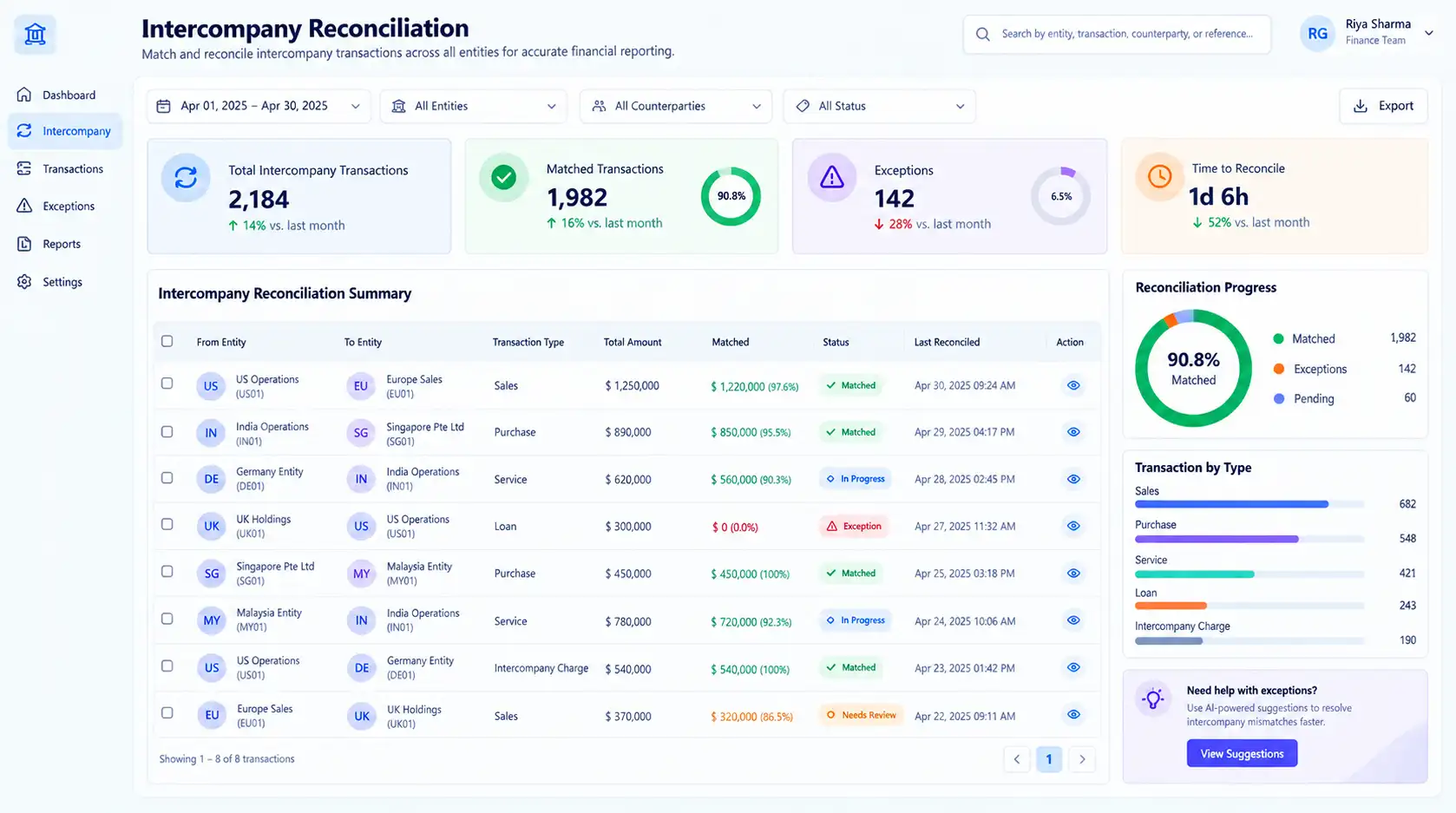
Most groups still reconcile intercompany balances over email, with one entity's accountant sending a spreadsheet to another and waiting days for a reply. Kosh AI removes that back-and-forth. It pulls transactions from every entity's books, matches them against each other directly, and tells you exactly where two entities disagree before consolidation starts.
You don't need to change how your entities book transactions. Kosh AI reads both sides of every intercompany relationship and handles the matching, the flagging, and the elimination.
Every corporate group is organized differently. Kosh AI fits the entity relationships you manage, the industry you work in, and the size of your consolidation team.
Goods and services billed between entities are matched on both sides, with markups and margins tracked correctly.
Loan balances and accrued interest between entities are reconciled each period, with currency effects separated out.
Shared service and overhead allocations are matched to confirm both the billing and receiving entity agree on the amount.

Cash and asset transfers between entities are tracked so a transfer recorded by one side is never left unmatched on the other.
Cross-entity inventory transfers and intercompany cost of goods sold are matched before they reach consolidation.
Intercompany royalty and service fee arrangements are reconciled automatically across subsidiaries.
Regional entities' intercompany purchases and markups are reconciled continuously as volume grows.
Shared service charges across hospital and clinic entities are reconciled with a clear trail for audit.
Kosh AI reconciles intercompany activity across complex, multi-entity groups, giving consolidation teams a clean set of balances every period.
Kosh AI helps growing groups reconcile intercompany balances without adding staff at each new entity.
Reconciling intercompany balances by hand usually means chasing other entities for their numbers and waiting on replies before consolidation can even start. Kosh AI removes that wait.
Intercompany balances are confirmed before close day instead of holding up the group close.
Both sides of every transaction are matched directly, so timing gaps don't get mistaken for real errors.
Entity teams resolve disputes in a shared system instead of waiting on email replies across time zones.
Elimination entries are prepared directly from confirmed balances, with nothing built manually at the last minute.
See which entity pairs are reconciled and which still need resolution, across the whole organization.
Every match and every elimination keeps its supporting detail, so group audits move faster.
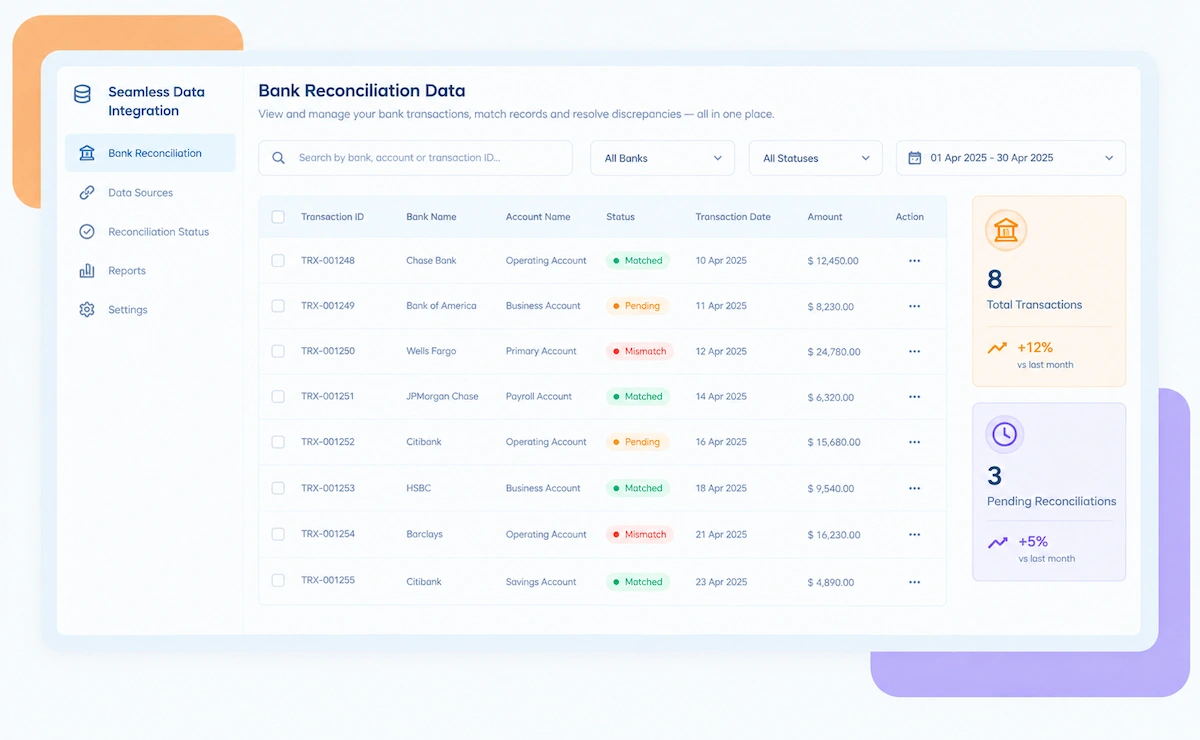
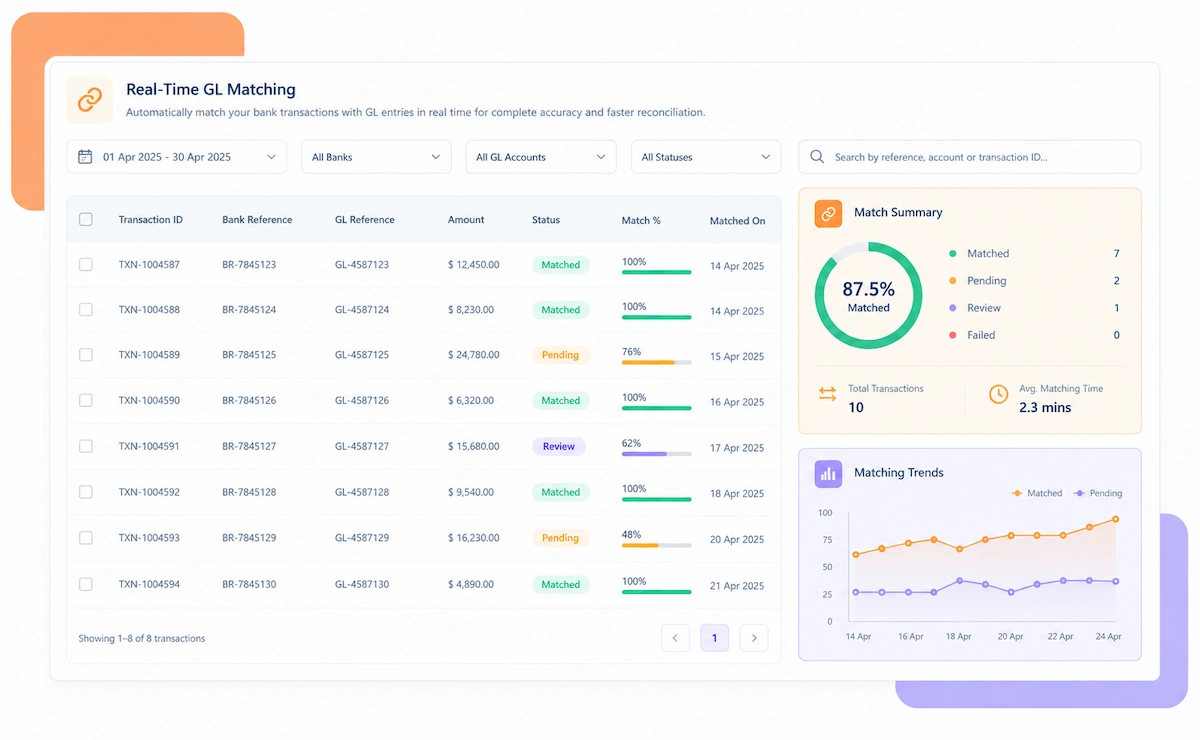
Kosh AI connects directly with all major banks and ERPs, enabling real-time data sync for faster, more accurate reconciliations—no manual uploads, no delays.


Email threads and shared spreadsheets break down the moment two entities update their numbers at different times. Kosh AI is built to keep both sides in sync automatically.
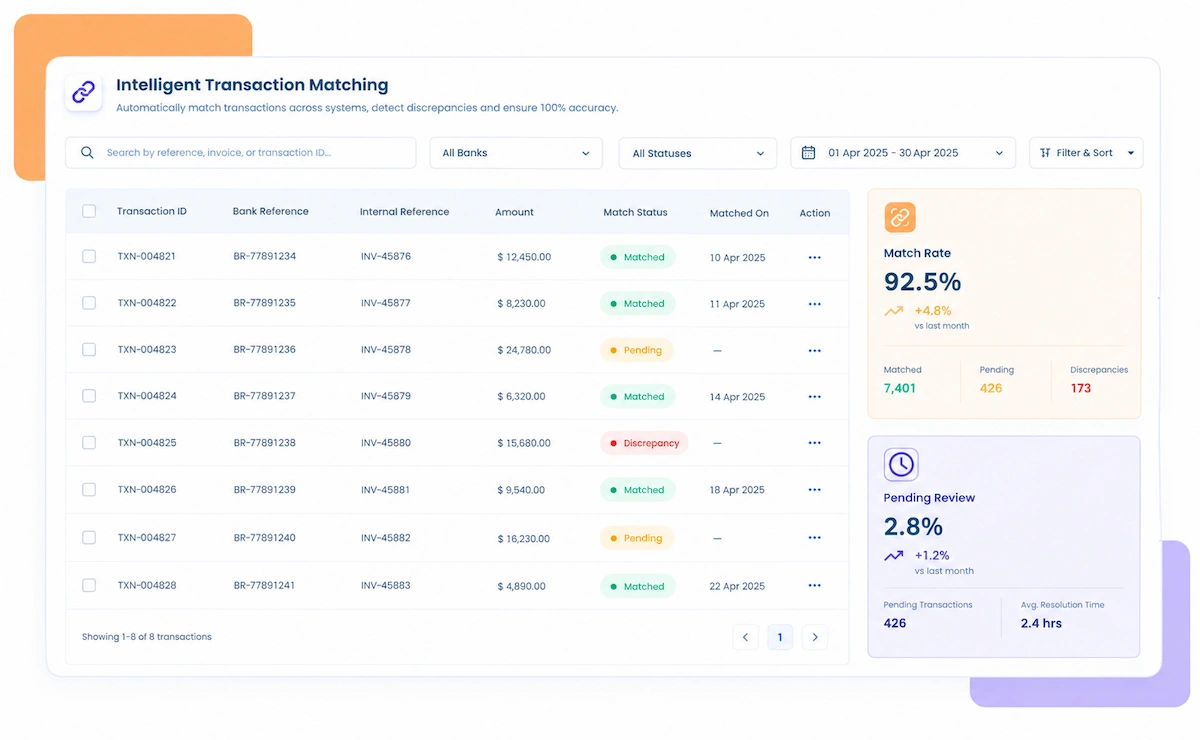
Kosh AI compares what each entity recorded directly, instead of relying on one entity's numbers alone.
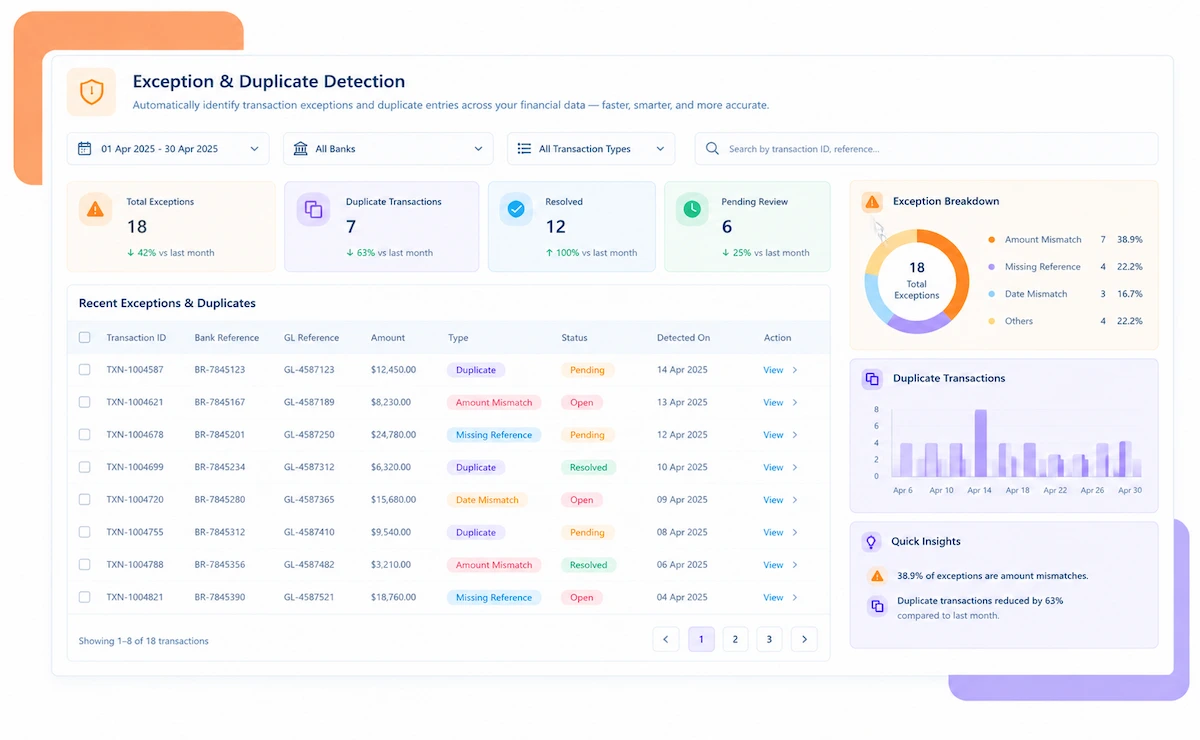
A mismatch is shown to both entities with the context they need, not left as a one-sided flag.
Each dispute your entities resolve helps Kosh AI match similar transactions correctly next period.

From a single intercompany invoice to a web of loans and allocations, Kosh AI matches it across every entity pair.
Intercompany reconciliation software matches transactions recorded between entities within the same corporate group—sales, loans, cost allocations, and transfers—to confirm both sides agree on the amount before consolidation. It pulls transaction data directly from each entity's books, so your consolidation team can see which entity pairs are reconciled and which still have an unresolved difference, without waiting on spreadsheets passed back and forth. Kosh AI goes further by matching both sides automatically, flagging genuine discrepancies apart from timing or currency differences, and preparing elimination entries once balances are confirmed. The result is a group close that doesn't stall on intercompany disputes.

Here's what actually changes when intercompany reconciliation moves off email threads and onto software built for it.
| What You're Comparing | Automated Intercompany Reconciliation | Doing It Manually |
|---|---|---|
| How Fast Disputes Get Resolved | Both entities see the mismatch and resolve it in the same system. | Resolution waits on email replies, often across time zones. |
| Room for Error | Matching compares both entities' records directly. | Relying on one entity's spreadsheet can hide the other side's version. |
| Handling More Entities | New entities and relationships are added without extra reconciliation staff. | More entities usually mean more spreadsheets and more emails to track. |
| Getting the Data In | Pulls transactions directly from every entity's ERP or ledger. | Each entity exports and sends its own balances separately. |

| Cost Over Time | Less manual chasing keeps the ongoing cost of consolidation down. | Relies on recurring staff hours across every entity, every period. |
| Seeing Group Status | A live view of every entity pair's reconciliation status. | Status is only known once every entity has replied. |
Set up Kosh AI, start matching entity-to-entity transactions automatically, and close your group books without the usual back-and-forth.

Schedule a Quick DemoIntercompany accounting has a built-in trap that regular reconciliation doesn't: an entry can look perfectly correct on one entity's books and still be wrong, simply because the entity on the other side of the transaction recorded something different. A loan Entity A books at one amount might not match what Entity B recorded if there was a timing gap, a currency conversion difference, or a simple data entry error. Neither side's books are individually broken, but together they don't agree, and that disagreement has to be resolved before the group's consolidated numbers can be trusted.
The usual way this gets handled—emailing spreadsheets between entity accountants—works at a small scale but breaks down fast as a group grows. More entities means more pairs to check, and the number of pairs grows much faster than the number of entities itself. A group with five entities might have ten entity-pair relationships to reconcile; a group with twenty entities has closer to two hundred. Manual coordination simply can't keep up with that kind of growth without adding real headcount dedicated to nothing but chasing replies.
Automating intercompany reconciliation isn't just about saving time on the back-and-forth, although that's a real benefit. It's about giving every entity team visibility into both sides of a transaction at once, so disagreements get caught and resolved while there's still time, instead of becoming a last-minute scramble that delays the whole group's consolidated close.
It matters most once a group's structure reaches a certain level of complexity.
Whoever owns the consolidated close needs intercompany balances confirmed early, not discovered as a surprise during the group close.
The number of entity pairs to reconcile grows faster than the number of entities, which is exactly where manual coordination breaks down.
Currency translation adds another layer of complexity to matching, which is harder to manage consistently by hand.
Each new acquired entity adds new intercompany relationships to track, often on a completely different ERP system.
Cost allocations from a shared service entity to many others create a high volume of intercompany entries that need routine checking.
A documented, two-sided reconciliation trail is exactly what group auditors look for when testing intercompany eliminations.
It's worth understanding both the upside and the real effort involved before rolling this out across a group.
Intercompany reconciliation software matches transactions recorded between entities in the same corporate group—sales, loans, allocations, and transfers—to confirm both sides agree on the amount before consolidation. Kosh AI does this automatically, comparing both entities' records and flagging genuine mismatches.
It pulls transaction data directly from each entity's ERP or ledger, then compares what one entity recorded against what the other entity recorded for the same transaction. Balances that match within tolerance are confirmed automatically, and anything that doesn't gets flagged for both entities to resolve.
Consolidation can't finalize cleanly while entities disagree on intercompany balances, and tracking down those differences by email slows the whole group close. Intercompany reconciliation software surfaces mismatches early and keeps both sides' records aligned, so consolidation isn't waiting on manual back-and-forth.
Account reconciliation checks a single entity's balance against its own supporting records. Intercompany reconciliation compares two entities' records against each other for the same transaction, since both sides need to agree before the balance can be eliminated in consolidation. Kosh AI handles both as part of the same close.
It separates genuine discrepancies from differences caused purely by currency translation, so a loan balance that looks mismatched only because of exchange rate movement isn't flagged the same way as an actual recording error. Kosh AI applies your group's translation policy automatically during matching.
Yes, once an intercompany balance is confirmed by both entities, Kosh AI prepares the elimination entry directly from the matched transaction, following your group's consolidation policy and chart of accounts, so nothing has to be built manually at close.
Yes, since group entities often run different systems, intercompany reconciliation software needs to connect to each one separately. Kosh AI integrates with SAP, Oracle, NetSuite, Sage, QuickBooks, and Xero, so entities on different platforms can still be reconciled against each other.
Both entities' recorded amounts are shown side by side with a likely reason for the gap, and the item is routed to both teams to resolve together in the system. It stays flagged and visible to consolidation until both sides confirm it's settled.
Most groups can have their primary entity pairs reconciling automatically within a few weeks, since the software connects to each entity's existing ERP. Kosh AI follows a similar timeline, with larger groups spanning many entities typically taking 3 to 6 months for full rollout.
Start with how many entities and currencies you manage and how much of your current process depends on email exchanges. From there, compare options on two-sided matching accuracy, ERP connectivity across different systems, and elimination entry automation. Kosh AI is built around exactly that checklist, but it applies to any software you're evaluating.
Book a demo and watch Kosh AI reconcile your own intercompany transaction data.
Book a Demo