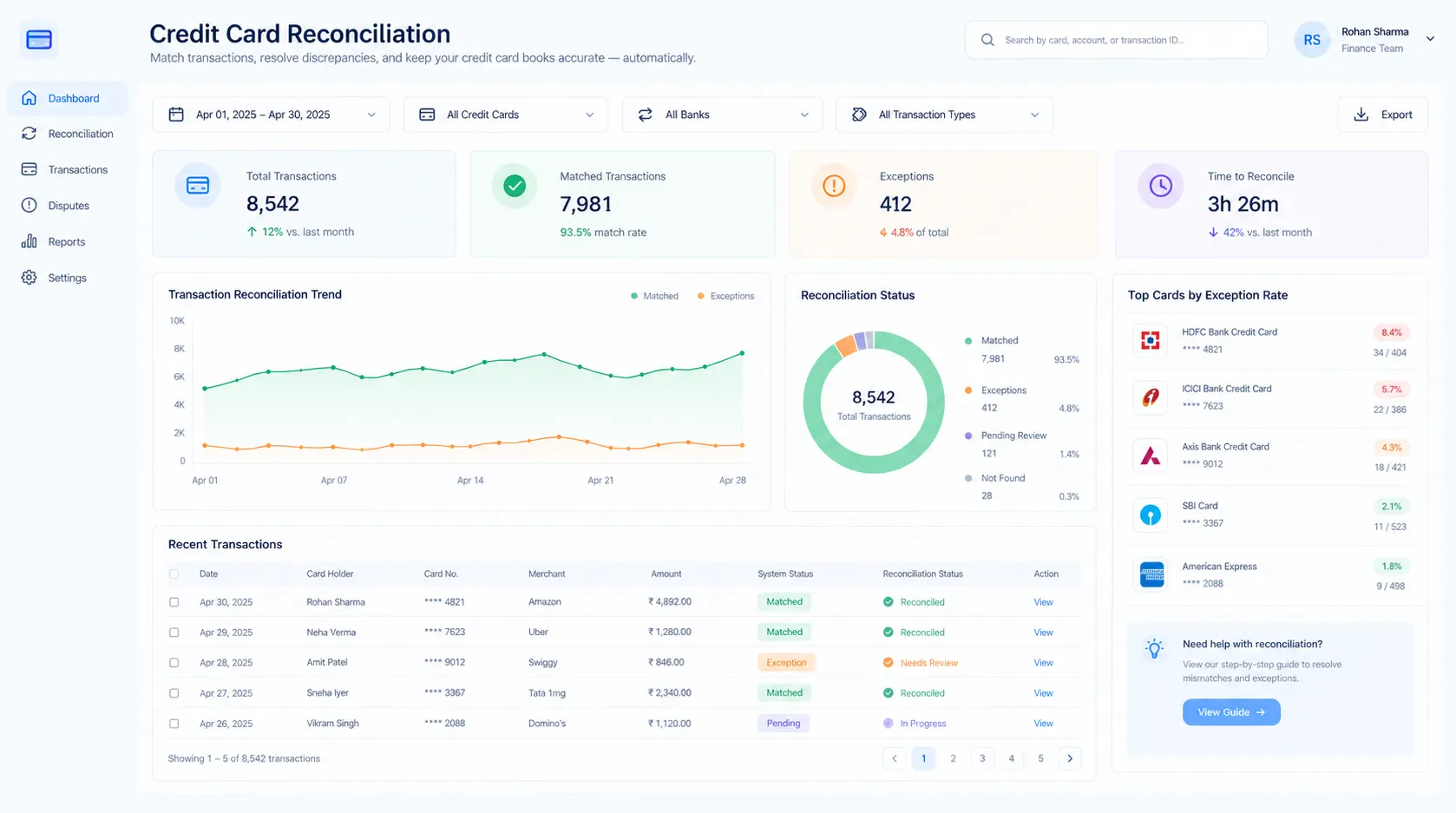
Let Kosh AI Match Every Card Transaction While Your Team Focuses on Spend Policy, Not Statements
Most finance teams still reconcile card accounts the same way they did years ago: download a statement, open a spreadsheet, and match each charge to a receipt or GL entry by hand. Kosh AI replaces that routine. It pulls card statements, receipts, and ledger data into one place, matches them automatically, and tells you exactly which charges need a second look.
You don't need to switch card issuers or change your expense policy. Kosh AI reads what's already there and handles the matching, the checking, and the sign-off.
No two businesses use cards the same way. Kosh AI fits the card programs you run, the industry you work in, and how your finance team is structured.
Employee card spend is matched to receipts and expense policy automatically, cutting down on manual expense review.
High-volume virtual card spend on recurring purchases is matched to purchase orders and vendor invoices.
Incoming card payments from customers are matched against daily sales, with interchange fees separated automatically.
Card rewards and rebates are reconciled against program terms, so earned value doesn't go unclaimed or untracked.
Procurement card spend across many cardholders is reconciled against purchase records daily instead of at month-end.
Software subscription spend on corporate cards is reconciled against budget owners without a side spreadsheet.
High-volume merchant card settlements are matched to daily sales and fees every day, not just at period close.
Patient card payments are reconciled against billed amounts with records clean enough to hold up under audit.
Kosh AI centralizes card reconciliation for large finance teams, giving real-time visibility and built-in controls across every cardholder and entity.
Kosh AI gives mid-market finance teams automated card matching without the headcount a manual process usually needs.
Reconciling card statements by hand ties up your finance team for days every cycle, and the pressure to close on time makes it easy to miss a missing receipt. Kosh AI takes that load off your team and gives you card accounts you can trust.
Statements that used to take hours to check clear on their own, freeing up days of staff time every cycle.
Every charge is checked the same way, every time, so a missing receipt stops surfacing only at audit time.
Instead of matching statement lines to receipts in spreadsheets, your team spends its time on charges that actually need judgment.
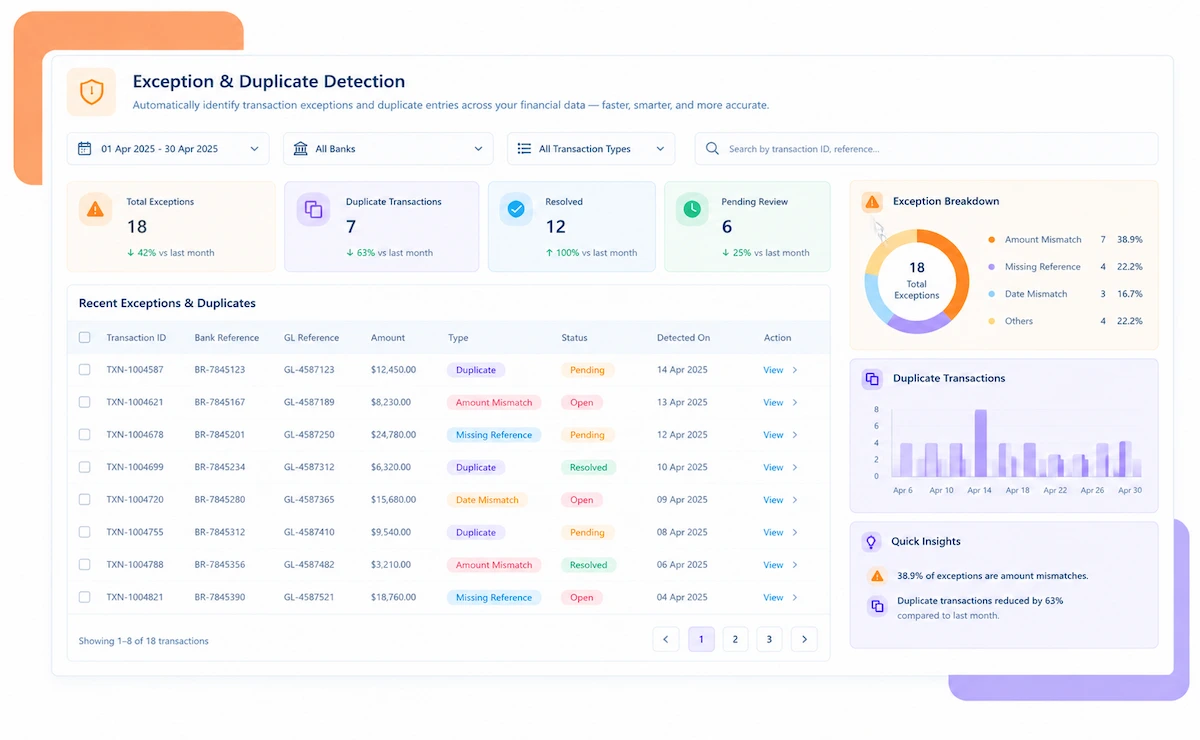
Out-of-policy spend is flagged as it happens, not discovered weeks later in a quarterly review.
See which accounts are reconciled, which are open, and which need attention, without checking every issuer portal.
Every matched transaction keeps its receipt and coding attached, so audit requests get answered in minutes.
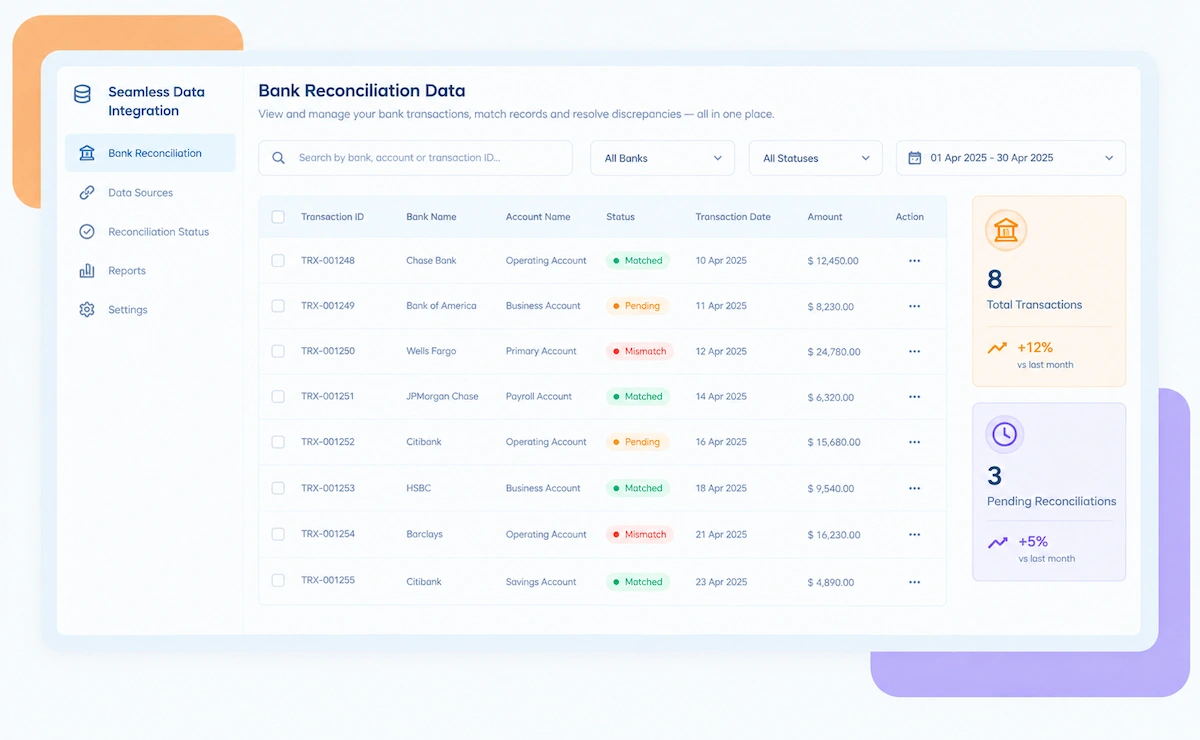
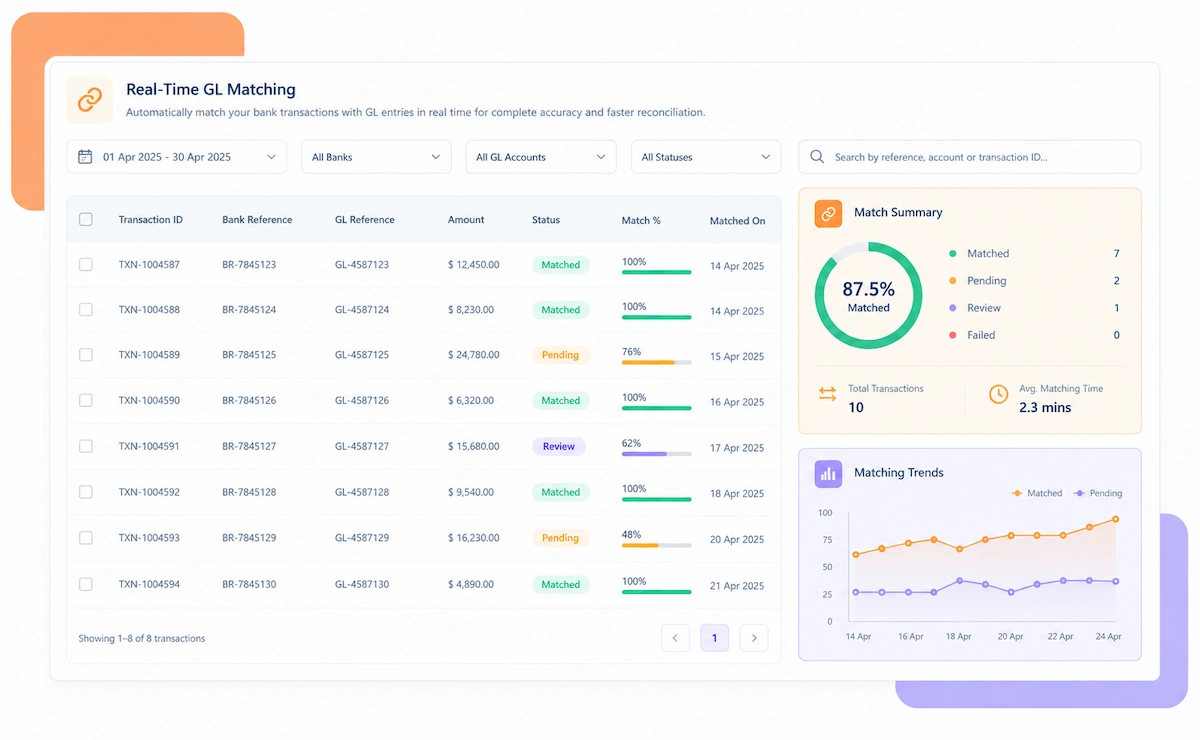
Kosh AI connects directly with all major banks and ERPs, enabling real-time data sync for faster, more accurate reconciliations—no manual uploads, no delays.


A shared spreadsheet breaks down the moment card volume climbs, or a cardholder forgets to log a receipt. Kosh AI is built for how a finance team actually manages card programs.
Kosh AI applies logic suited to each cardholder's typical spend pattern, not one rigid rule forced onto every charge.
A charge without a receipt comes with the cardholder and amount flagged, not just a generic gap to chase.
Every correction your team makes feeds back into how Kosh AI codes similar charges next cycle.
From a simple T&E charge to a merchant settlement batch with interchange fees, Kosh AI handles the matching logic each one needs.
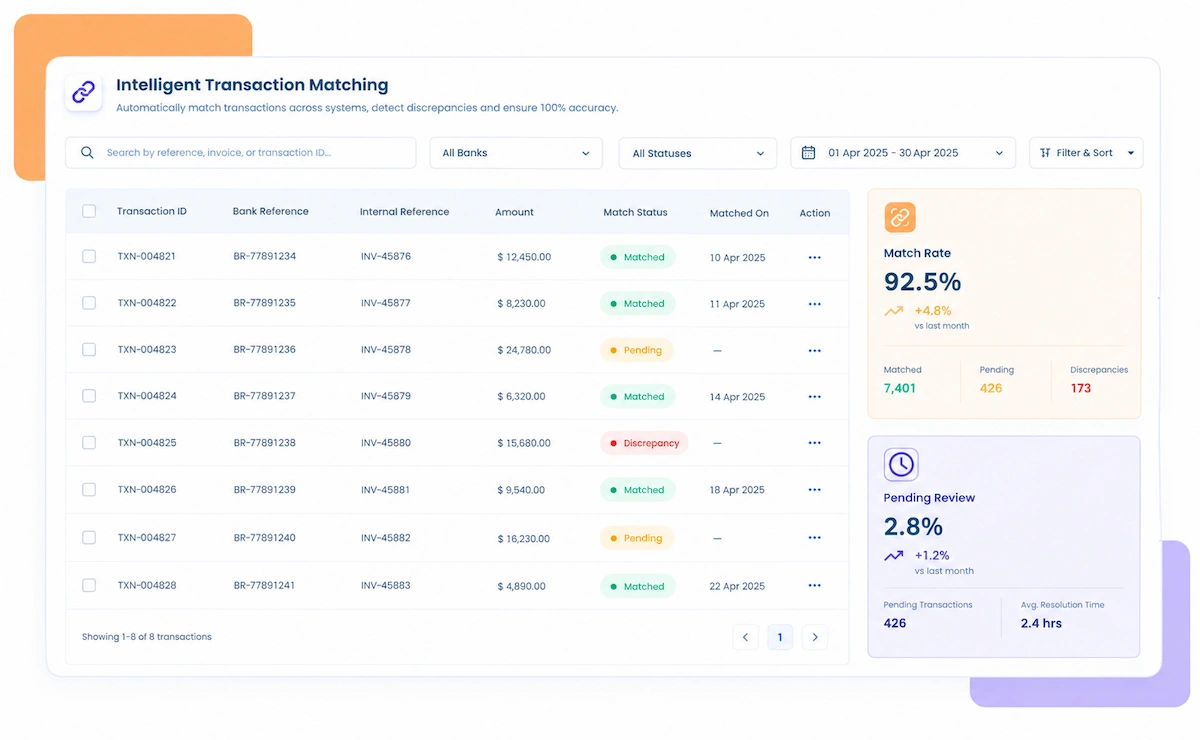
Credit card reconciliation software checks every card transaction—corporate card spend, procurement card purchases, or merchant settlements—against its supporting receipt, GL coding, or sales record, confirming the amount is correct before the books close. It pulls data straight from your card issuer or payment processor and your ERP, so your finance team sees which charges tie out and which don't, without matching a statement to receipts by hand in a spreadsheet. Kosh AI takes it further by clearing correctly matched charges on its own, flagging missing receipts and policy exceptions with a likely cause, and keeping supporting documentation attached to every match. The result is card accounts your finance team can close faster and defend with confidence.

Here's what actually changes when credit card reconciliation moves off spreadsheets and onto software built for finance teams.
| What You're Comparing | Automated Credit Card Reconciliation | Doing It Manually |
|---|---|---|
| How Fast Statements Are Matched | Most charges reconcile within hours of a statement loading. | Each charge is checked line by line, often over several days. |
| Room for Error | Matching logic applies the same way to every cardholder, every time. | Missed receipts and miscoded charges are easy to overlook under deadline pressure. |
| Handling More Cardholders | New cardholders and card programs are added without extra headcount. | A growing card program usually means more people needed to keep up. |
| Getting the Data In | Pulls statement, receipt, and ledger data directly through live connections. | Someone has to download statements and collect receipts by hand. |
| Cost Over Time | Less manual effort keeps the ongoing cost of reconciliation down. | Relies on hours of staff time every single cycle. |
| Seeing Card Account Status | A live view of which accounts are reconciled, open, or flagged. | Status usually means checking in with cardholders individually. |

Set up Kosh AI, start matching card statements automatically, and close your next cycle with accounts you already trust.
Schedule a Quick DemoAs a business issues more cards, works with more cardholders, or simply processes more transactions, matching every card charge to a receipt and the right GL account becomes a real strain on a finance team. A controller who could once chase down a handful of missing receipts personally ends up relying on cardholders to self-report, and that's exactly where problems creep in—a receipt that never gets submitted, a charge coded to the wrong department, a settlement batch that's "probably right" without anyone confirming the fees. Credit card reconciliation software exists to close that gap before it turns into an expense policy violation or a surprise during the audit.
The case for using it isn't just about saving time, though that's part of it. It's about consistency: every charge gets checked the same way, every cycle, whether it's a routine office supply purchase or a large procurement card order. That consistency is what lets finance close card accounts with actual confidence instead of hoping every cardholder submitted their receipts. It also means your team spends its hours on judgment calls—is this charge really out of policy, does this settlement discrepancy need escalating—rather than on the mechanical work of matching statement lines to receipts.
There's a growth angle too. A business with a handful of corporate cards can often get by with manual checks and a disciplined monthly routine. The moment that grows to dozens or hundreds of cardholders across multiple card programs, manual reconciliation simply can't keep pace without adding headcount every time the card program expands. Credit card reconciliation software is built to scale with that growth instead of forcing you to hire your way through it, which is a large part of why finance teams bring it in well before a compliance issue forces the decision.
It's not only for large enterprises with hundreds of cardholders. Here's who tends to get the most value from it.
Anyone responsible for closing card accounts benefits from having every charge matched automatically before month-end.
Once cardholder count and transaction volume outpace what a spreadsheet-based process can reasonably handle, it's time to automate.
Reconciling merchant settlements against daily sales and interchange fees is exactly the repetitive work automation handles best.
If audit season means weeks of scrambling to document card spend, automated matching builds that trail year-round instead.
Automatic policy exception detection catches violations as they happen instead of during a quarterly review.
Finance leaders under pressure to control spend need a reconciliation process that doesn't trade speed for accuracy.
No tool is a perfect fit for every business. Here's an honest look at what credit card reconciliation software gets right, and what's worth planning around before you adopt it.
Credit card reconciliation software checks every card transaction against its supporting receipt, GL coding, or sales record, instead of a person matching a statement by hand each cycle. Kosh AI does this automatically, clearing matched charges and flagging anything that doesn't tie out.
It pulls statement data from your card issuer or processor and ledger data from your ERP, then compares each charge against its receipt and GL coding using rules your team sets. Charges that match cleanly get cleared automatically, and anything that doesn't gets flagged with a likely reason for review.
A reconciliation process that depends on manually checking every card statement gets slower and riskier as cardholder count grows. Credit card reconciliation software keeps that process consistent regardless of volume, which matters for closing on time, catching missing receipts, and enforcing expense policy.
In practice, any recurring card activity benefits, but corporate and T&E cards, procurement cards, and merchant settlement accounts are usually the highest priority since they carry the most volume. Kosh AI supports all of these account types out of the box.
Payment reconciliation software covers matching across every payment channel a business handles. Credit card reconciliation software focuses specifically on card statements, receipts, and interchange fees, including both outbound card spend and inbound merchant settlements. Kosh AI handles both under one system.
Yes, most credit card reconciliation software is built to pull statement data directly from card issuers and ledger data from common ERPs. Kosh AI connects to major card issuers and expense platforms alongside SAP, Oracle, NetSuite, Sage, QuickBooks, and Xero, so data flows in without manual exports.
No, it complements one. An expense management tool helps cardholders submit receipts and get approvals; credit card reconciliation software confirms that what was submitted actually matches the statement and the GL. Kosh AI works alongside the expense tools you already use.
It gets flagged immediately, usually routed to the cardholder or their manager for follow-up with the charge amount and date already attached. From there, it stays visible until a receipt is provided or the charge is otherwise resolved, so it doesn't sit unnoticed until month-end.
Most businesses can have core card accounts reconciling automatically within a few weeks, since the software connects to issuers and an ERP you already use. Kosh AI follows a similar timeline, with more complex, multi-program rollouts typically taking 2 to 4 months to fully configure.
Start with how many cardholders and card programs you manage and how much of your reconciliation is still manual today. From there, compare options on matching accuracy, issuer and ERP connectivity, policy exception detection, and how well it fits your existing expense workflow. Kosh AI is built around exactly that checklist, but it applies to any software you're comparing.

Book a demo and watch Kosh AI reconcile your own card statement and expense data.
Book a Demo