Let Kosh AI Match Every International Payment While Your Team Manages Global Operations
Most global finance teams still reconcile cross-border payments the same way they did years ago: pull a SWIFT confirmation, open a spreadsheet, and work out the FX difference by hand. Kosh AI replaces that routine. It pulls payment and FX data straight from your banks, lines it up against what was sent and received, and tells you exactly which international payments need a second look.
You don't need to change banking partners or restructure how you pay international suppliers or receive foreign receivables. Kosh AI reads what's already there and handles the matching, the FX math, and the reporting.
No two businesses move money internationally the same way. Kosh AI fits the payment corridors you use, the industry you work in, and how your global finance team is structured.
Outbound payments to overseas vendors are matched against invoices with FX differences accounted for automatically.
Incoming payments from international customers are matched to invoices even when the received amount differs from the billed amount.
Transfers between entities in different countries are reconciled on both sides, with FX and timing differences resolved consistently.
Payments routed through intermediary banks are tracked and matched despite the fees and delays those chains introduce.
Cross-border supplier payments across many currencies are matched daily, keeping global procurement cash flow visible.
International subscription receivables are reconciled automatically, without finance teams manually tracking every FX conversion.
Payments to overseas manufacturers and distributors are matched against purchase orders across every currency used.
High-volume cross-border trade payments are reconciled with records clean enough to satisfy international audit requirements.
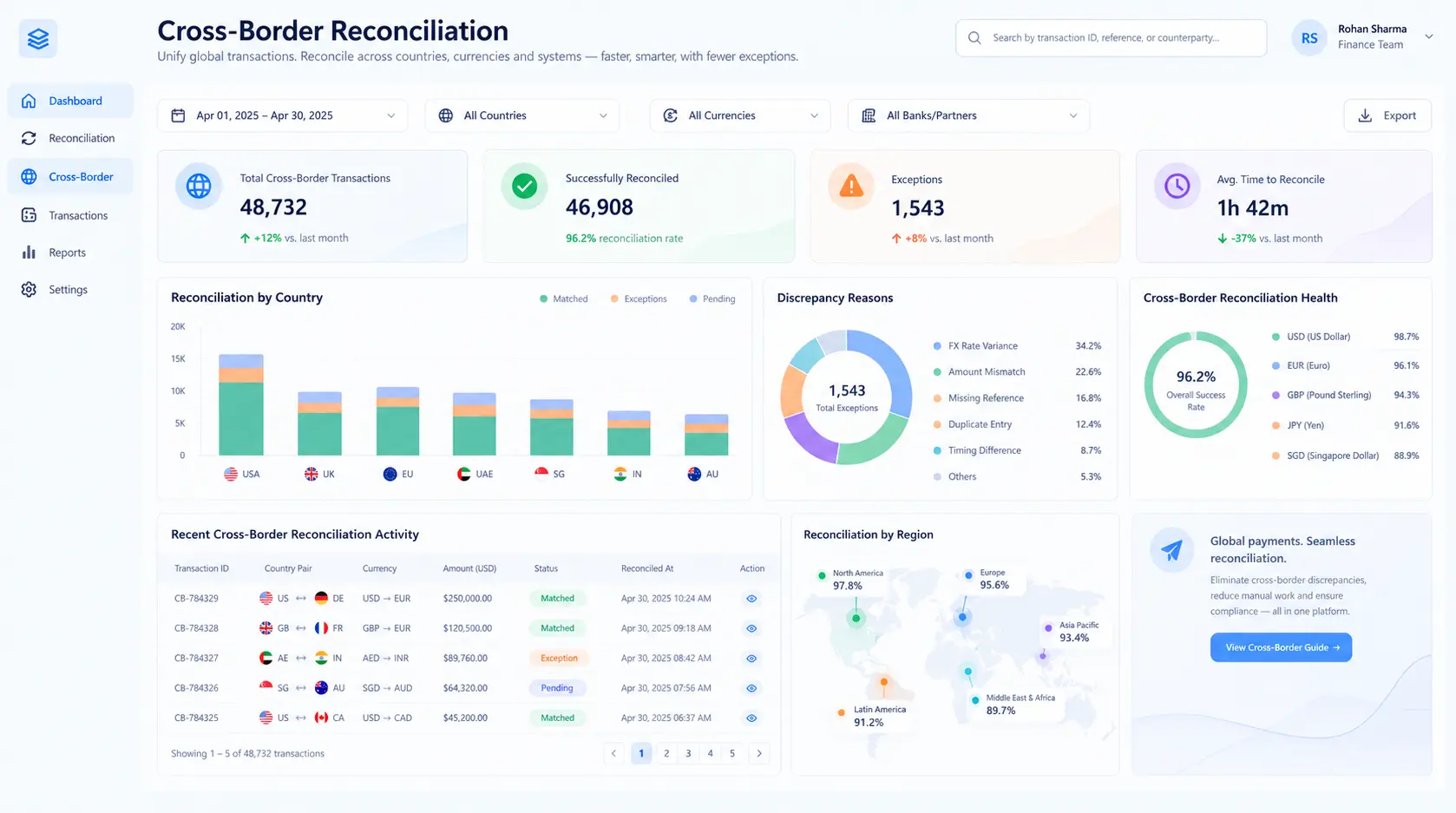
Kosh AI centralizes cross-border reconciliation for global finance teams, giving real-time visibility and built-in controls across every currency corridor.
Kosh AI gives expanding businesses automated cross-border matching without the headcount a manual FX reconciliation process usually needs.
Reconciling international payments by hand means untangling FX rates, fees, and delays for every single transfer, and the pressure to close on time makes it easy to miss something. Kosh AI takes that load off your team and gives you a global cash position you can trust.
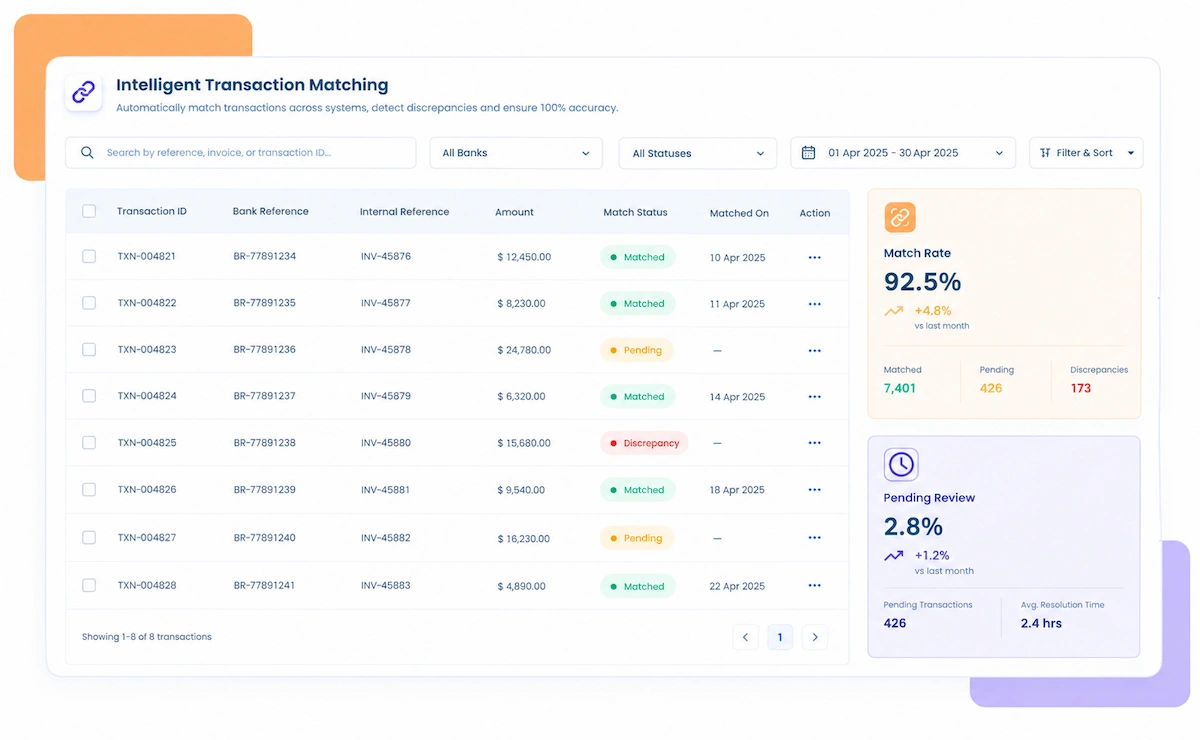
International payments that used to take hours to untangle clear on their own, freeing up time across every close cycle.
Exchange rate and fee differences are calculated automatically, so a normal conversion stops looking like a discrepancy.
Instead of calculating exchange rates by hand in spreadsheets, your team spends its time on payments that actually need judgment.
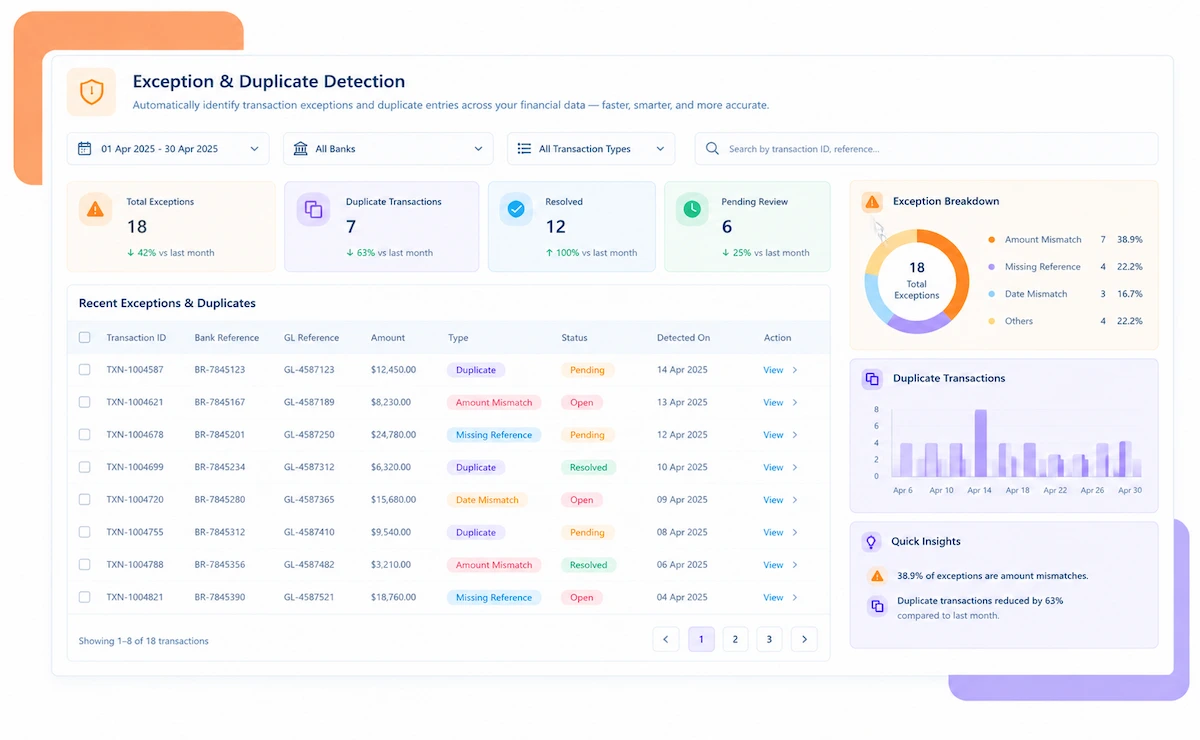
Stuck or slow-moving cross-border payments are flagged early, not discovered when a reconciliation won't tie out.
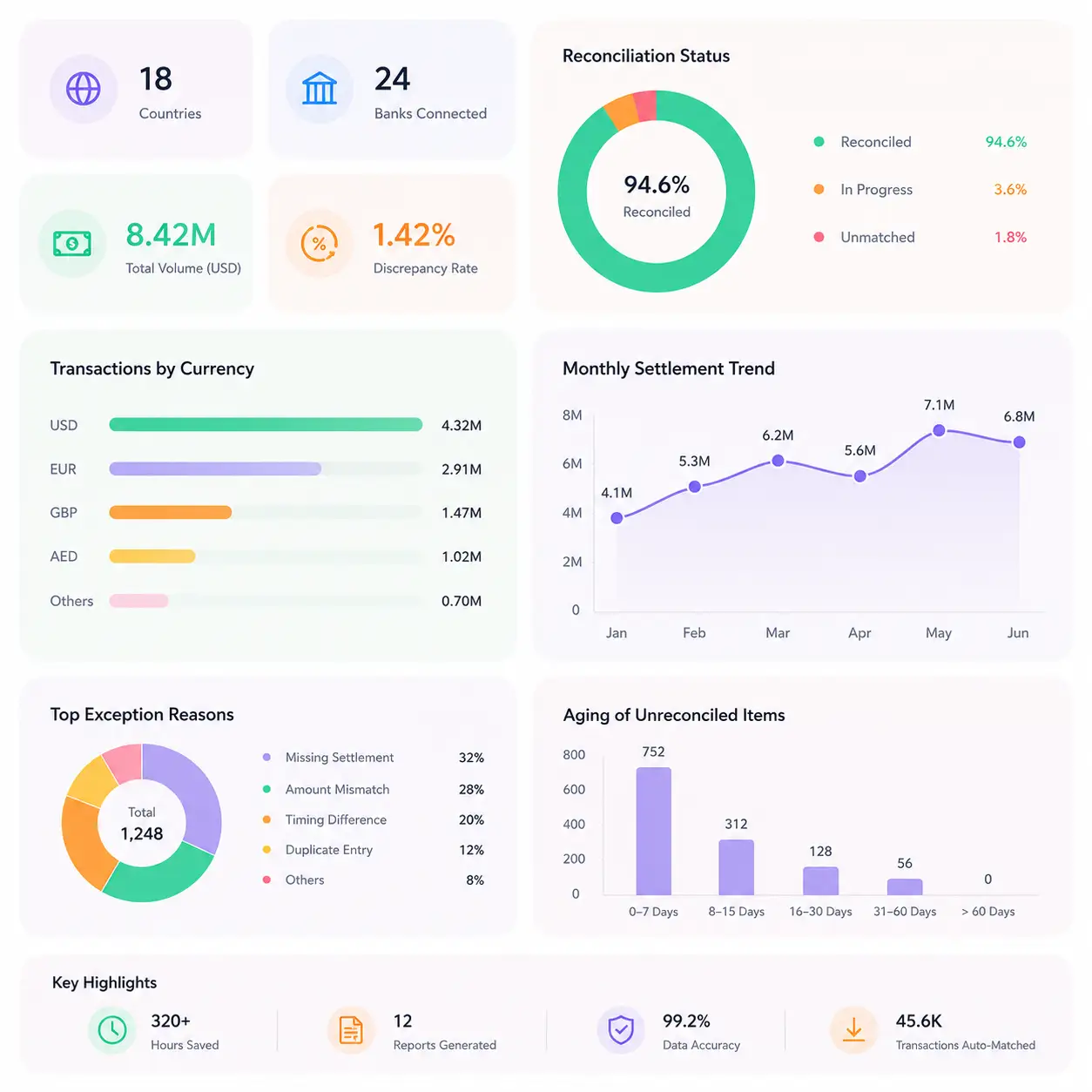
See which international payments are matched, which are delayed, and which need attention, by corridor and by entity.
Every matched payment keeps its FX rate and fee breakdown attached, so cross-border audits get answered in minutes.
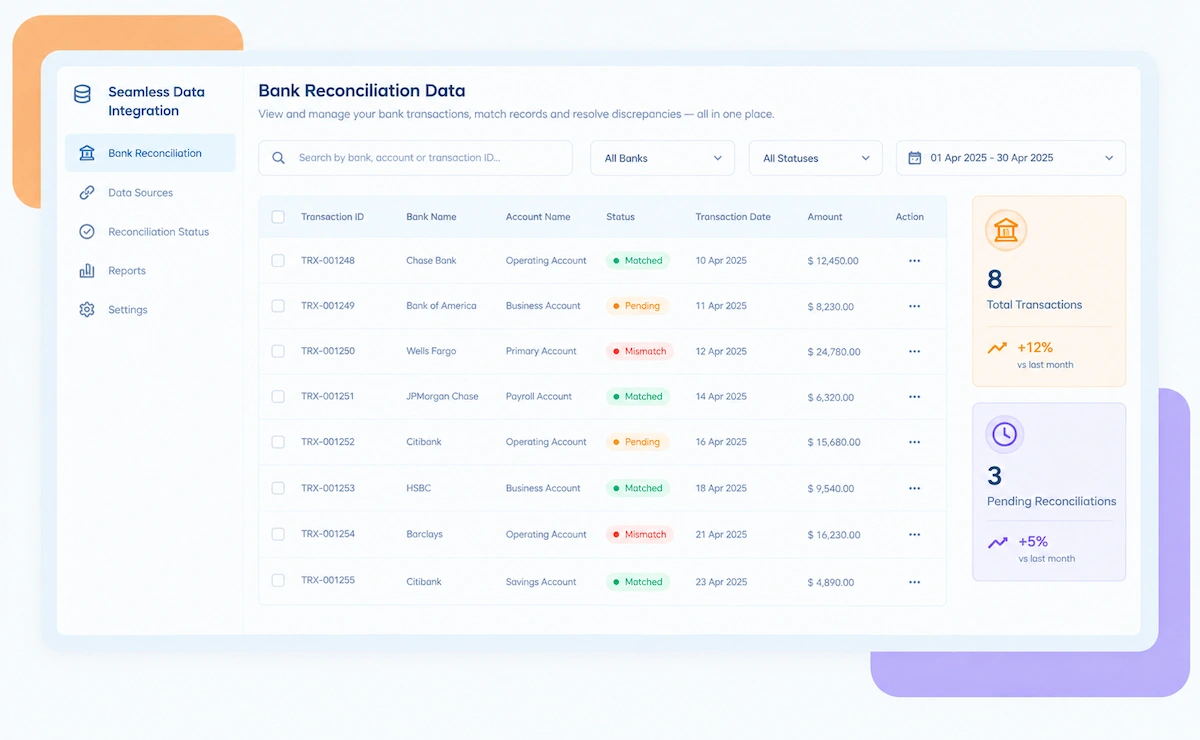
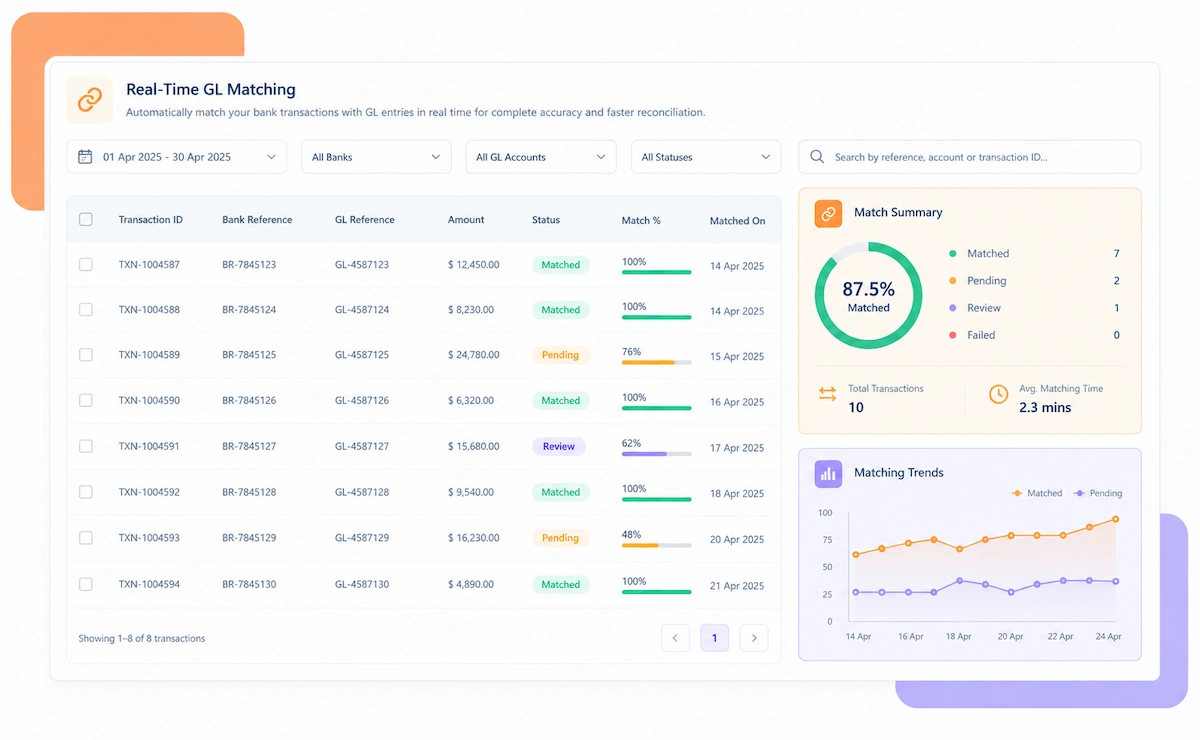
Kosh AI connects directly with all major banks and ERPs, enabling real-time data sync for faster, more accurate reconciliations—no manual uploads, no delays.


A shared spreadsheet struggles the moment FX rates, intermediary fees, and time zones enter the picture. Kosh AI is built for how a global finance team actually reconciles money moving across borders.
Kosh AI applies logic suited to each currency corridor's typical rates and fees, not one rigid rule forced onto every payment.
A delayed or mismatched international payment comes with a likely reason and a suggested action, not just a red flag.
Every correction your team makes feeds back into how Kosh AI reconciles that currency corridor next time.

From a simple two-currency transfer to a payment routed through several intermediary banks, Kosh AI handles the reconciliation logic each one needs.
Reconciling international payments well comes down to a few habits most global teams know but struggle to apply consistently. Here's what Kosh AI helps enforce automatically.
Reconciling against the real rate at the time of transfer avoids chasing phantom variances caused by rate assumptions.
Correspondent and intermediary bank fees should be tracked on their own line, not lumped into an unexplained variance.
Knowing a corridor's typical settlement window helps distinguish a normal delay from a payment that's actually stuck.
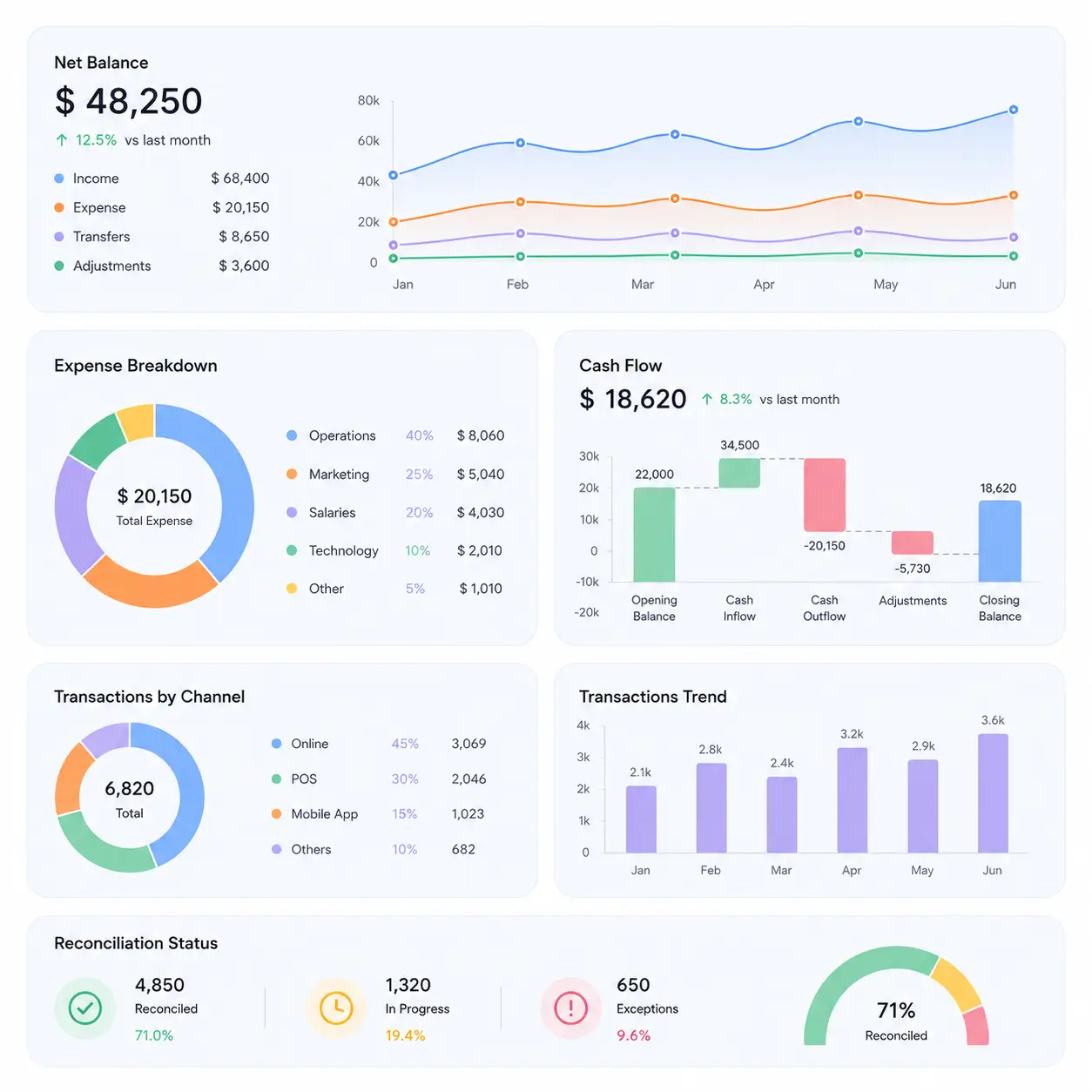
A single view across every currency and entity prevents cross-border cash from being managed in disconnected silos.
Cross-border reconciliation software checks international payments sent or received across different currencies and banking systems against the transactions they're meant to settle, accounting for exchange rates, intermediary fees, and settlement delays along the way. It pulls payment and FX data straight from your banks and payment providers, so your finance team sees which international payments tie out and which don't, without manually calculating currency conversions in a spreadsheet. Kosh AI takes it further by clearing correctly matched payments on its own, flagging genuine discrepancies separately from normal FX differences, and keeping the full rate and fee breakdown attached to every match. The result is a global cash position your finance team can report and defend with confidence.

A domestic payment either matches or it doesn't. A cross-border payment almost never arrives at the exact amount it was sent for, because exchange rates move between when a payment is initiated and when it settles, and correspondent banks along the way often take a fee out of the transfer. When reconciliation is done by hand, someone has to manually work out whether a difference is a normal FX conversion, a bank fee, or an actual error—and under deadline pressure, it's easy to either miss a real discrepancy or waste hours investigating a difference that was never a problem.
This gets harder as a business expands into more countries and currencies. A handful of payment corridors can usually be tracked with a disciplined spreadsheet process and some institutional knowledge about typical rates and fees. Once that grows to dozens of currencies and banking relationships, manual reconciliation starts missing real issues—a payment stuck in an intermediary bank, a fee that's higher than usual, a rate that was applied incorrectly—simply because there's too much variation across corridors for a person to track reliably. Cross-border reconciliation software exists to apply that same careful judgment consistently, across every currency, every time.

Here's what actually changes when cross-border reconciliation moves off spreadsheets and onto software built for global finance teams.
| What You're Comparing | Automated Cross-Border Reconciliation | Doing It Manually |
|---|---|---|
| Handling FX Differences | Exchange rates and fees are calculated automatically at the time of transfer. | Someone has to manually work out whether a difference is FX, fees, or an error. |
| Spotting Stuck Payments | Payments exceeding typical settlement time for their corridor are flagged automatically. | A stuck payment is often only noticed when someone asks where it went. |

| Handling More Currencies | New currency corridors are added without extra headcount. | Expanding into new countries usually means more people needed to track new corridors. |
| Getting the Data In | Pulls payment and FX data directly from banks and payment providers. | Someone has to pull SWIFT confirmations and rate sheets and paste them into a spreadsheet. |
| Cost Over Time | Less manual FX calculation keeps the ongoing cost of reconciliation down. | Relies on hours of staff time every single period, across every corridor. |
| Seeing Global Cash Position | A live, reconciled view of cash across every currency and entity. | Status usually means waiting for someone to finish converting and reconciling each corridor. |

Not every reconciliation tool is built for international payments. Here's what to walk through before picking one for your global finance team.
Set up Kosh AI, start matching international payments automatically, and close your next global period with numbers you already trust.
Schedule a Quick DemoCross-border reconciliation software checks international payments against the transactions they're meant to settle, accounting for exchange rates, intermediary fees, and settlement delays along the way. Kosh AI does this automatically, clearing correctly matched payments and flagging genuine discrepancies.
It pulls payment and FX data directly from your banks and payment providers, then matches each international payment against its source transaction while accounting for the exchange rate and fees applied. Payments that reconcile cleanly get cleared automatically, and anything that doesn't gets flagged for review.
Reconciling international payments by hand means manually untangling FX rates and bank fees for every transfer, which gets slower and riskier as more currencies and corridors are added. Cross-border reconciliation software keeps that process consistent, which matters for accurate reporting, catching stuck payments early, and having a clean trail ready for cross-border audits.
In practice, any international payment benefits, but supplier payments, foreign customer receivables, and intercompany cross-border transfers are usually the highest priority since they carry the most volume and the most FX complexity. Kosh AI supports all of these payment types out of the box.
Cash reconciliation software typically matches domestic bank transactions to the ledger. Cross-border reconciliation software adds the extra layer of handling exchange rates, correspondent bank fees, and multi-currency reporting that international payments require. Kosh AI handles both under one system.
Yes, most cross-border reconciliation software is built to connect to banks and payment providers across multiple countries. Kosh AI connects to major global banking partners alongside ERPs like SAP, Oracle, NetSuite, Sage, QuickBooks, and Xero, so international payment data flows in without manual downloads.
No, but it takes most of the manual FX calculation work off their plate. Kosh AI handles routine cross-border matching automatically, so treasury can focus on managing global liquidity and investigating payments that actually need judgment.
It gets flagged immediately, usually with a likely cause attached, whether that's an unusual FX rate, an unexpected fee, or a genuine delay. From there, it's routed for review with the full payment and rate detail already pulled up, so it doesn't sit unresolved until it affects reporting.
Most businesses can have their highest-volume currency corridors reconciling automatically within a few weeks. Kosh AI follows a similar timeline, with full rollouts across many currencies and banking partners typically taking 3 to 6 months to fully configure.
Start with how many currencies and banking partners you manage and how much of your FX reconciliation is still manual today. From there, compare options on FX rate handling, fee transparency, multi-currency reporting, and how well the software fits your global close calendar. Kosh AI is built around exactly that checklist, but it applies to any software you're comparing.
Book a demo and watch Kosh AI reconcile your own cross-border payment data.
Book a Demo