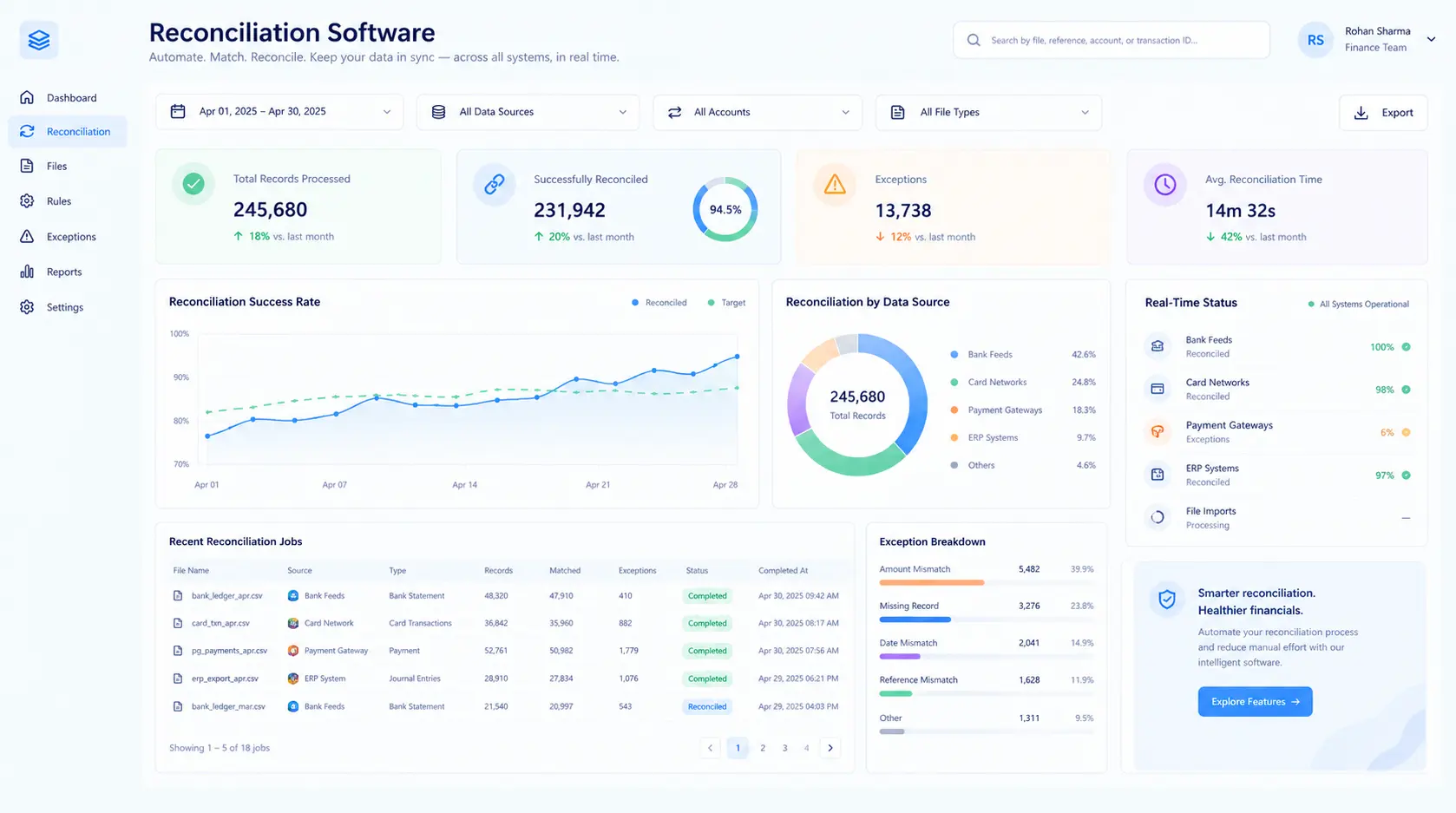
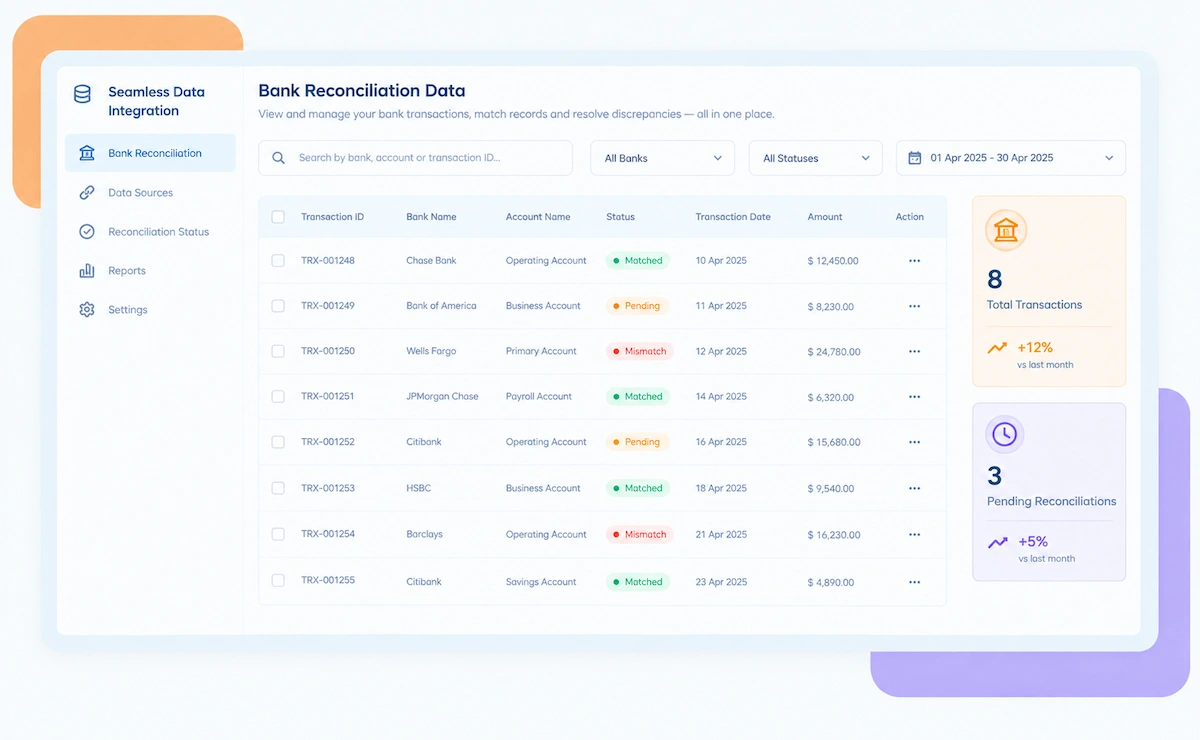
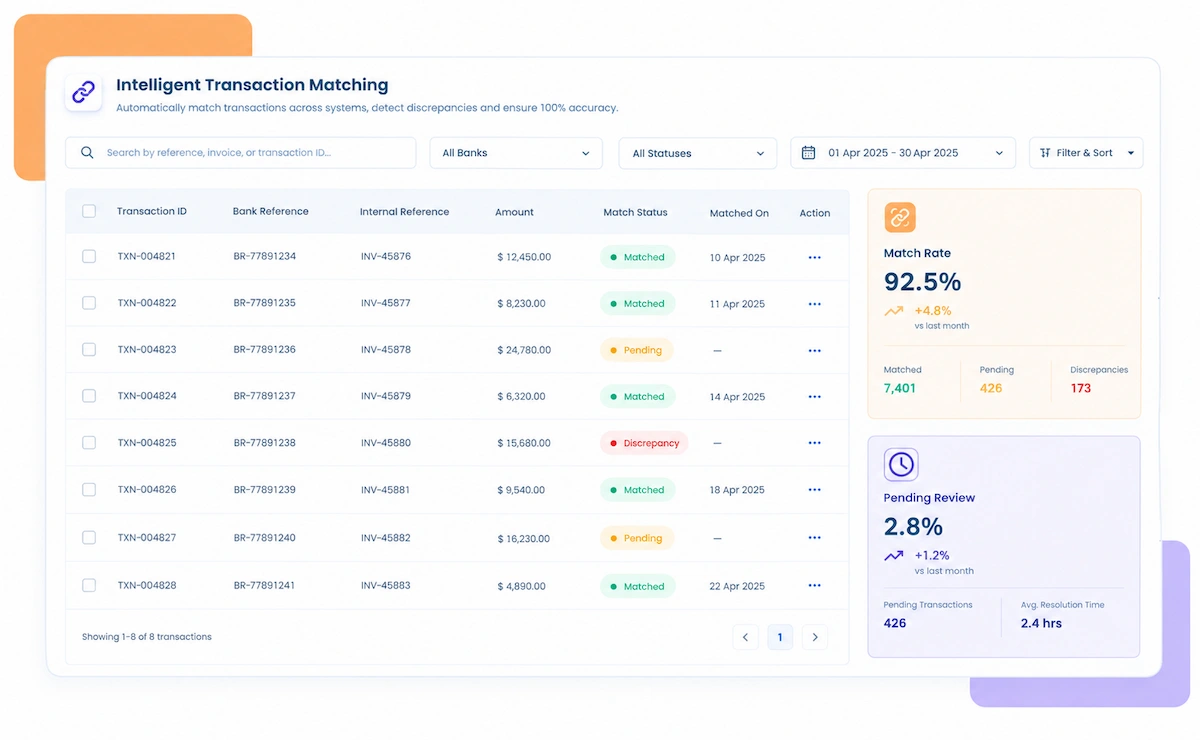
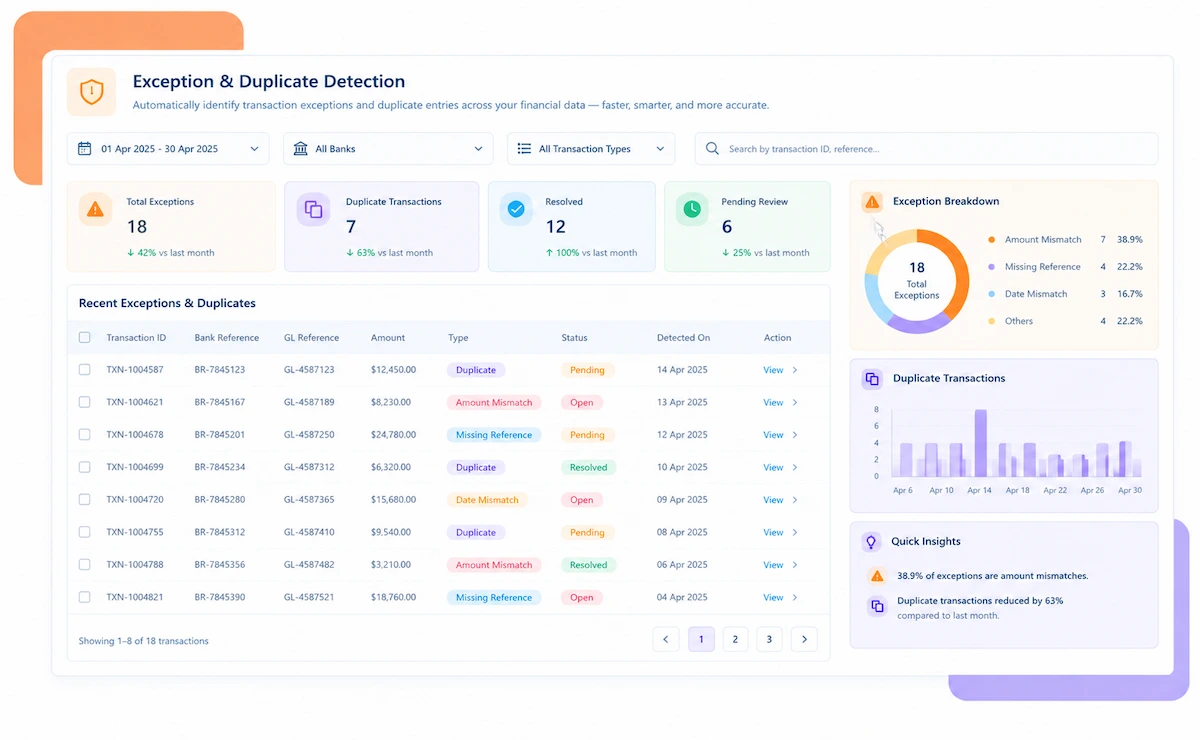
Let Kosh AI Run Bank, Ledger, Intercompany, and Payment Reconciliation From One Automated Engine

Most finance teams end up running a different reconciliation process for every data type: one spreadsheet for bank accounts, another for intercompany, another for payments. Kosh AI runs all of it through one engine, so your team isn't maintaining five versions of the same basic matching logic.
You don't need to standardize your data sources before getting started. Kosh AI reads what's already there across every system and handles the matching from there.
No two finance teams reconcile the exact same mix of data. Kosh AI fits the reconciliation types you run, the industry you work in, and how your finance team is structured.
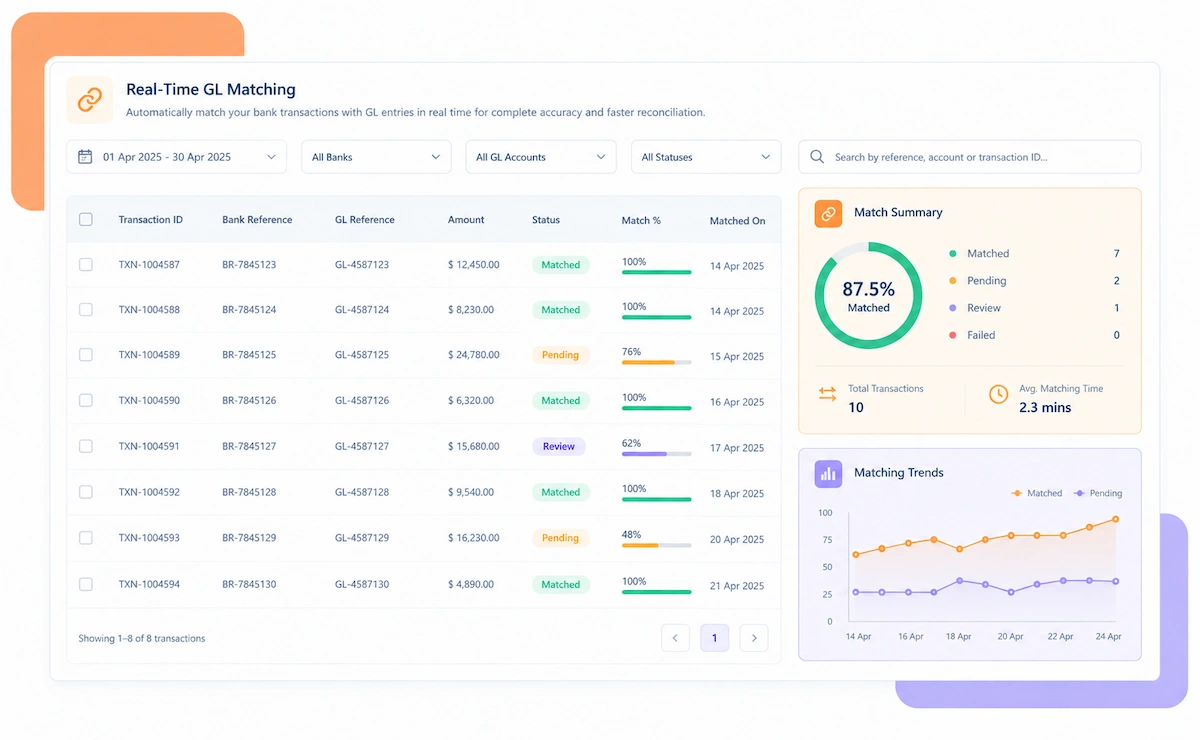
Bank statement activity is matched to the ledger as part of the same platform running every other reconciliation type.
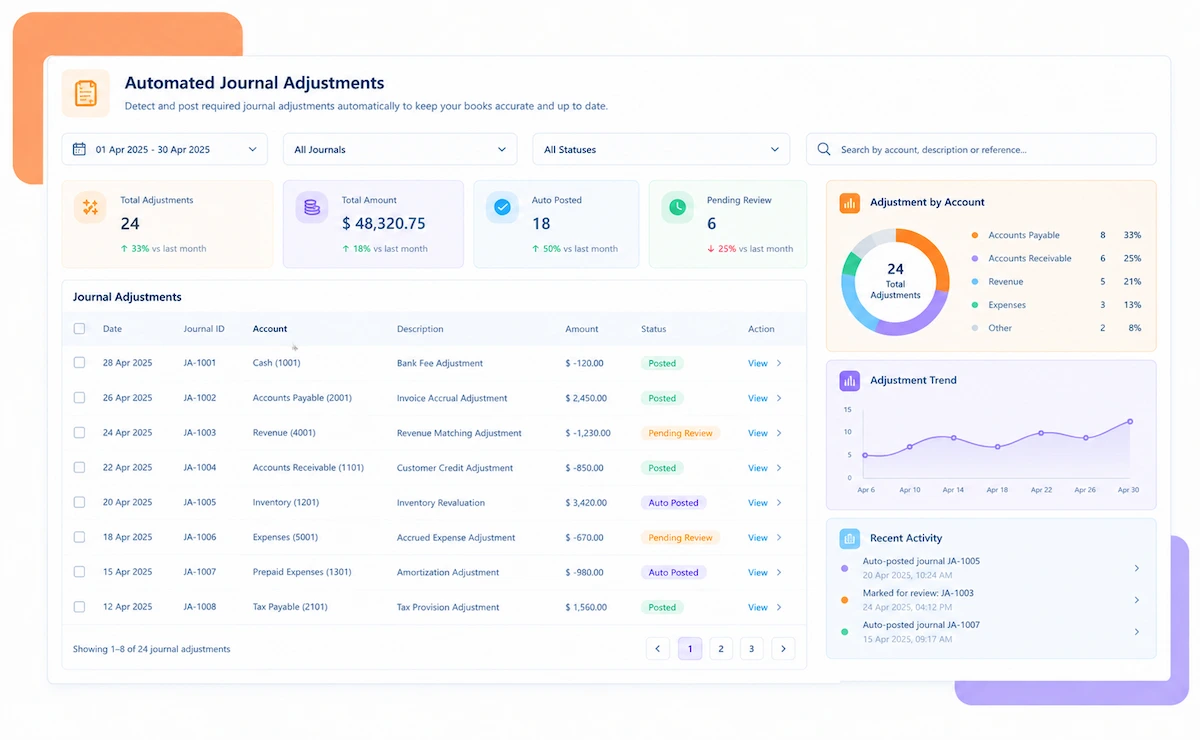
Balance sheet accounts are reconciled continuously, not just during a month-end push.
Intercompany balances across entities are matched automatically before consolidation.
Payment gateway and processor data is reconciled alongside bank and ledger data in one view.
Multiple reconciliation types across entities are run from one platform instead of several disconnected tools.
Payment and ledger reconciliation scale together as transaction volume grows with the business.
High-volume payment and bank reconciliation run without a manual spreadsheet review each week.
Complex, high-volume reconciliation across many account types runs on one consistent engine.
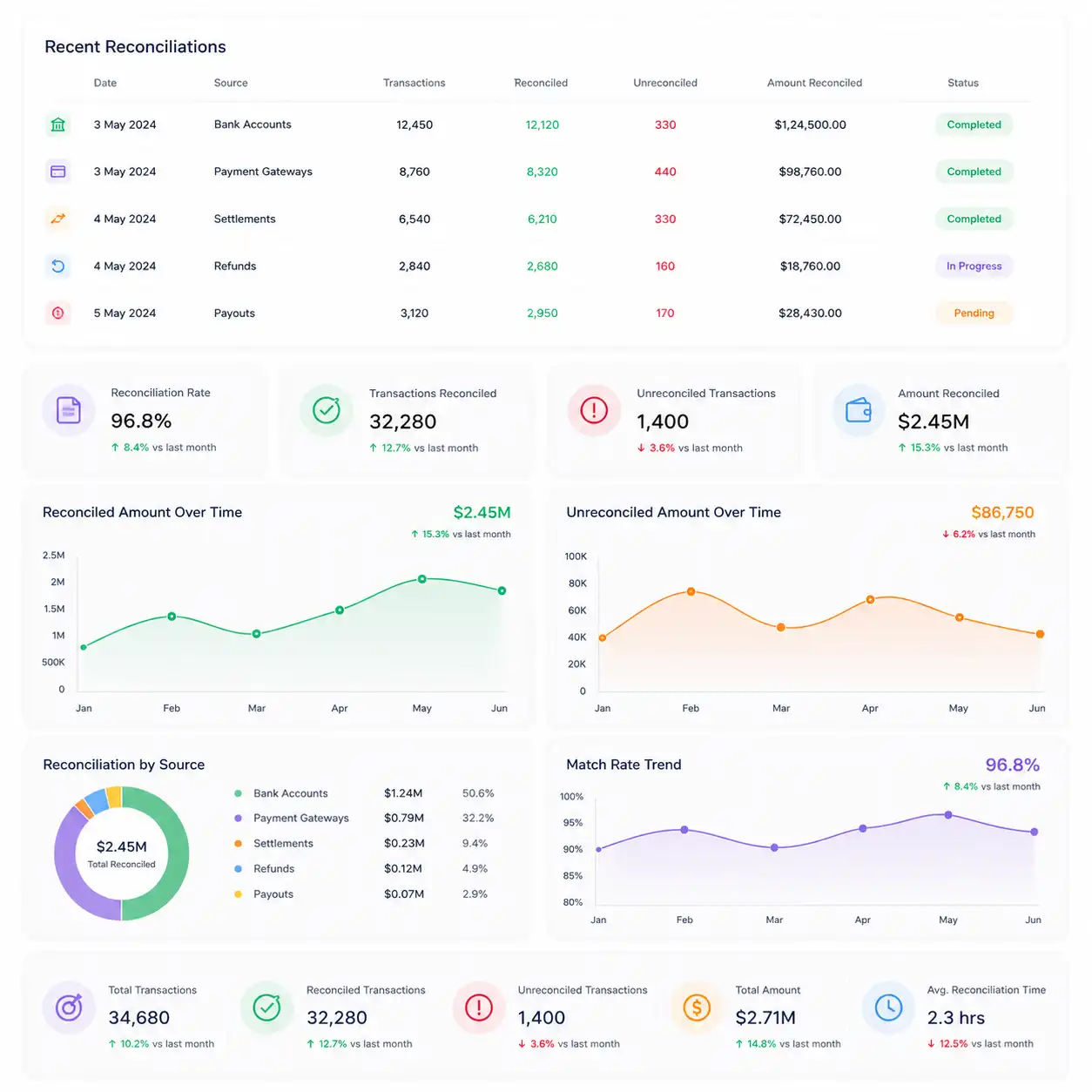
Kosh AI centralizes every reconciliation type for large finance teams, giving real-time visibility across the full close process.
Kosh AI gives smaller finance teams one reconciliation engine instead of a different spreadsheet for every data type.

Running a different reconciliation process for every data type means your finance team is maintaining several versions of the same basic matching logic. Kosh AI takes that load off your team and gives you one engine to rely on.

Bank, ledger, intercompany, and payment reconciliation all run from the same platform instead of five separate processes.
Continuous matching means most reconciliation work is already done by the time close starts.
Growing transaction volume doesn't require a proportional increase in reconciliation staff.
One engine applies consistent matching and exception logic everywhere, instead of some areas getting more attention than others.

Every match across every reconciliation type keeps its supporting detail attached without extra effort.
Instead of matching transactions by hand, your team spends its time interpreting what the numbers mean.
Kosh AI connects directly with all major banks and ERPs, enabling real-time data sync for faster, more accurate reconciliations—no manual uploads, no delays.


A point tool built for one reconciliation type usually does that one job well, but it leaves every other type running on its own separate process, which is exactly where inconsistency and duplicated effort creep in.

Bank, intercompany, and payment reconciliation each running on a different tool means no single view of overall reconciliation health.
Each separate tool or spreadsheet ends up reinventing similar matching rules instead of sharing one proven engine.
Without one unified process, higher-risk reconciliation types can get less scrutiny simply because they're tracked less visibly.
Reporting on reconciliation status across five separate tools means manually stitching together a summary that's already outdated.
A separate tool or spreadsheet for each reconciliation type breaks down the moment volume grows or a new data source gets added. Kosh AI is built to run every type from one consistent engine.
Kosh AI applies logic suited to each reconciliation type, while keeping the underlying matching engine consistent across all of them.
An exception comes with its reconciliation type, likely cause, and supporting data already attached.
Every resolved exception feeds back into how Kosh AI matches that data type going forward.
From bank and ledger reconciliation to intercompany and payments, Kosh AI handles the matching logic each one needs.
Automated reconciliation software applies one matching engine across every type of reconciliation a finance team runs, including bank, general ledger, intercompany, and payment reconciliation, instead of relying on a separate spreadsheet or tool for each. It pulls data from every connected source, matches transactions using logic that learns from your data, and flags anything that doesn't match with a likely cause attached. Kosh AI takes it further by running that matching continuously rather than only at period-end, so most reconciliation work is already done by the time close starts. The result is a finance team working from one consistent, audit-ready reconciliation process instead of several disconnected ones.

Here's what actually changes when reconciliation moves from separate point tools and spreadsheets to one automated engine.
| What You're Comparing | Automated Reconciliation Software | Separate Point Tools and Spreadsheets |
|---|---|---|
| Matching Logic Across Types | One engine applies consistent logic across bank, ledger, intercompany, and payment reconciliation. | Each reconciliation type usually has its own separate logic, built at different times. |
| Seeing Overall Reconciliation Health | One dashboard shows status across every reconciliation type. | Summarizing status across tools means manually stitching together separate reports. |
| Timing of Reconciliation Work | Matching happens continuously as transactions post. | Reconciliation is often concentrated into a period-end scramble. |
| Scaling With Transaction Volume | Growing volume doesn't require a proportional increase in reconciliation staff. | Higher volume usually means more manual hours across every separate tool. |
| Exception Consistency | Exceptions are flagged with the same rigor regardless of reconciliation type. | Some reconciliation types get more scrutiny than others simply due to visibility. |
| Maintaining Matching Rules | One engine's rules improve automatically as it learns from your data. | Each spreadsheet or tool's rules need separate, manual maintenance over time. |
Set up Kosh AI, run every reconciliation type through one engine, and close your books without stitching together five separate processes.
Schedule a Quick DemoNo platform is a perfect fit for every reconciliation setup. Here's an honest look at what automated reconciliation software gets right, and what's worth planning around before you adopt it.
Automated reconciliation software applies one matching engine across every reconciliation type a finance team runs, including bank, ledger, intercompany, and payment reconciliation. Kosh AI does this continuously, instead of relying on a separate spreadsheet or tool for each type.
It pulls data from every connected source, matches transactions using logic that learns from your data, and flags anything that doesn't match with a likely cause attached. Matching happens continuously, so most reconciliation work is done before period-end close even starts.
Running a different process for every reconciliation type means duplicated effort and inconsistent rigor. Automated reconciliation software gives every type the same proven engine, which matters for closing faster and catching discrepancies earlier.
In practice, any reconciliation type benefits, but bank, general ledger, intercompany, and payment reconciliation are the most common. Kosh AI supports all of these reconciliation types from one platform.
A single-purpose tool usually handles one reconciliation type well, such as bank or payment reconciliation, but leaves other types on separate processes. Automated reconciliation software unifies every type under one engine. Kosh AI offers both the unified platform and deep functionality within each reconciliation type.
Yes, most automated reconciliation software is built to pull data from common banks, ERPs, and payment systems. Kosh AI connects to major providers alongside SAP, Oracle, NetSuite, Sage, QuickBooks, and Xero, so data flows in without manual exports.
No, but it takes most of the manual matching work off their plate. Kosh AI handles routine reconciliation automatically across every type, so your finance team can focus on investigating genuine exceptions and interpreting results.
It gets flagged as an exception immediately, usually with a likely cause and the supporting data already attached. From there, it's routed for review instead of sitting unresolved until the next close.
Most businesses can have core reconciliation types running automatically within a few weeks, since the software connects to systems you already use. Kosh AI follows a similar timeline, with complex, multi-entity rollouts across every reconciliation type typically taking 3 to 6 months to fully configure.
Start with how many reconciliation types you currently run on separate tools or spreadsheets. From there, compare options on how many types they unify, matching accuracy, and how consistently exceptions are handled across types. Kosh AI is built around exactly that checklist, but it applies to any platform you're comparing.
Book a demo and watch Kosh AI reconcile your own bank, ledger, and payment data.
Book a Demo