Kosh AI Normalizes PayU India, LatAm, and Europe Settlement Data Into One Reconciliation, Even Though Each Region Reports It Differently
A business operating across PayU's regional footprint, India, Latin America, Central and Eastern Europe, deals with what are effectively different settlement systems wearing the same brand. Field names, settlement timelines, and report structures all differ by region. Kosh AI normalizes every regional format into a single reconciliation.
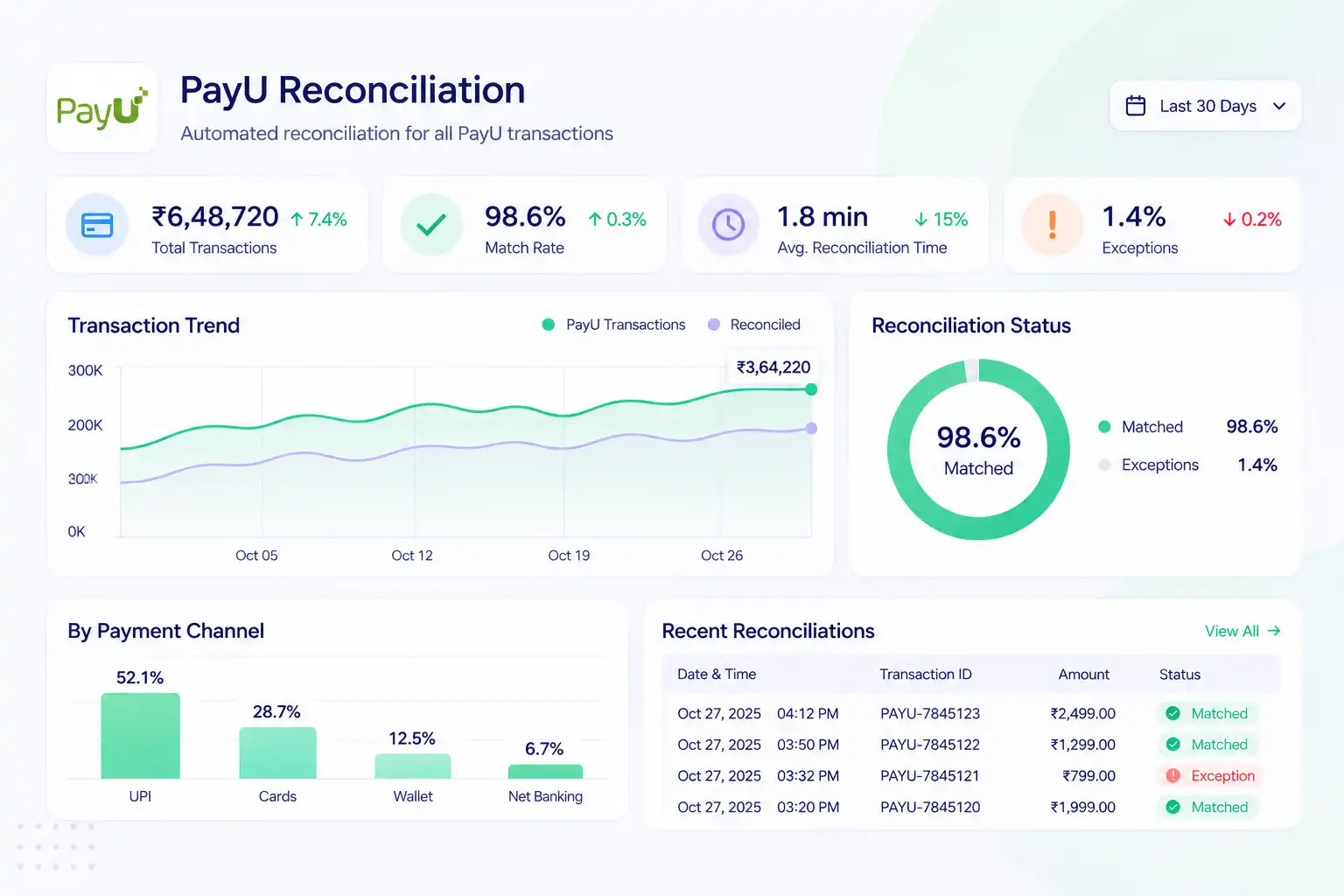
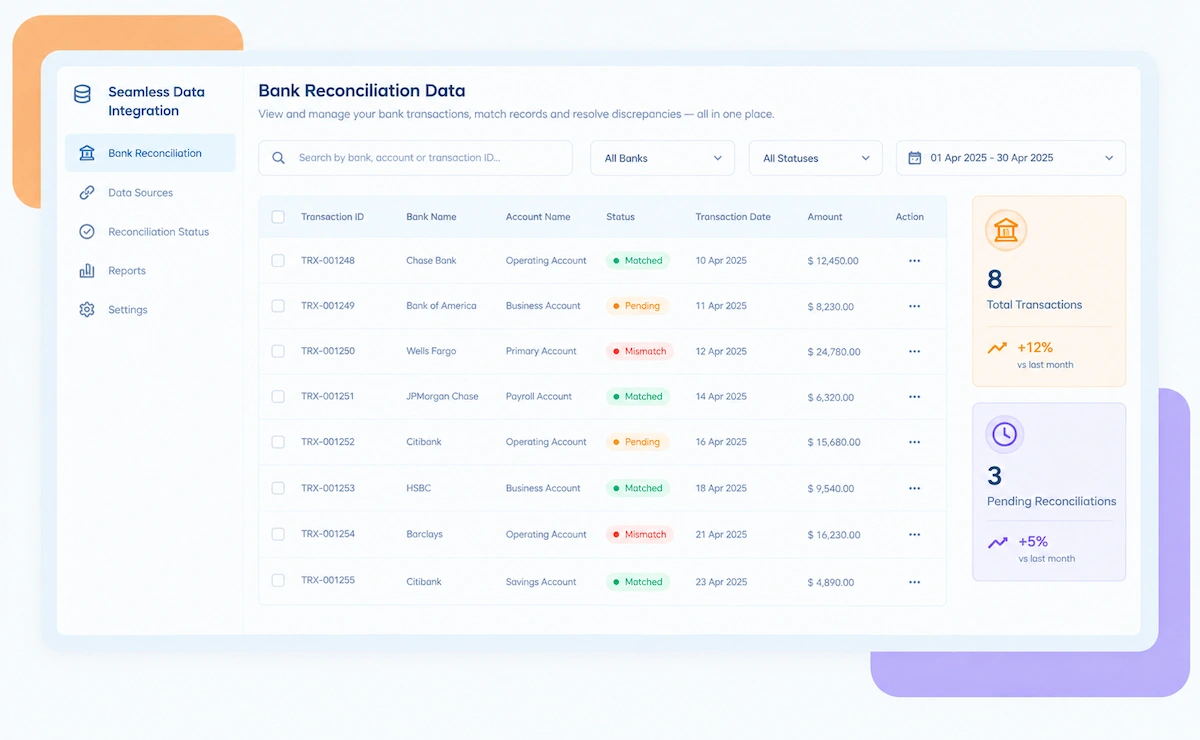
Kosh AI connects to every regional PayU entity you operate with and your bank statements, then normalizes all of it into one reconciliation.
Whether you operate in one PayU region or across several at once, Kosh AI reconciles PayU the way your business actually operates globally.
UPI, cards, and net banking settlements are matched using India-specific field formats and timelines.
Latin American settlement formats and local payment methods are normalized into the same reconciliation.
Central and Eastern European settlement data is matched using the correct regional timeline and fee schedule.
Businesses running several PayU regions at once get one consolidated reconciliation view.
High transaction volumes across regions are reconciled without a manual review each week.
New regions added over time are folded into the same normalized reconciliation.
Recurring PayU billing across regions is reconciled alongside one-off transactions.
Multi-entity, multi-currency PayU operations are reconciled with full audit trails.
Kosh AI reconciles high-volume PayU accounts across every region without manual review.
Kosh AI gives smaller finance teams automated cross-region matching without adding headcount as volume grows.
Each PayU region reports settlement data differently by default. Kosh AI normalizes all of it, so expansion into a new region doesn't mean a new reconciliation process.
PayU India, LatAm, and Europe settlement data all reconcile through the same normalized process.
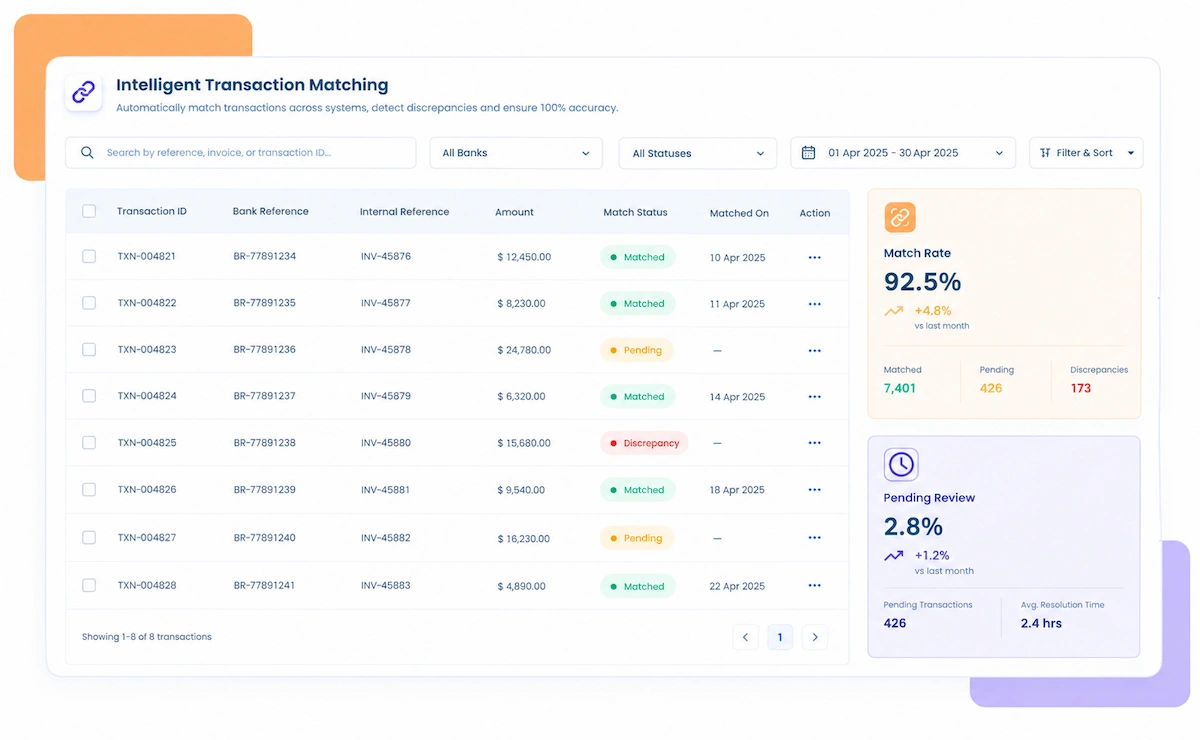
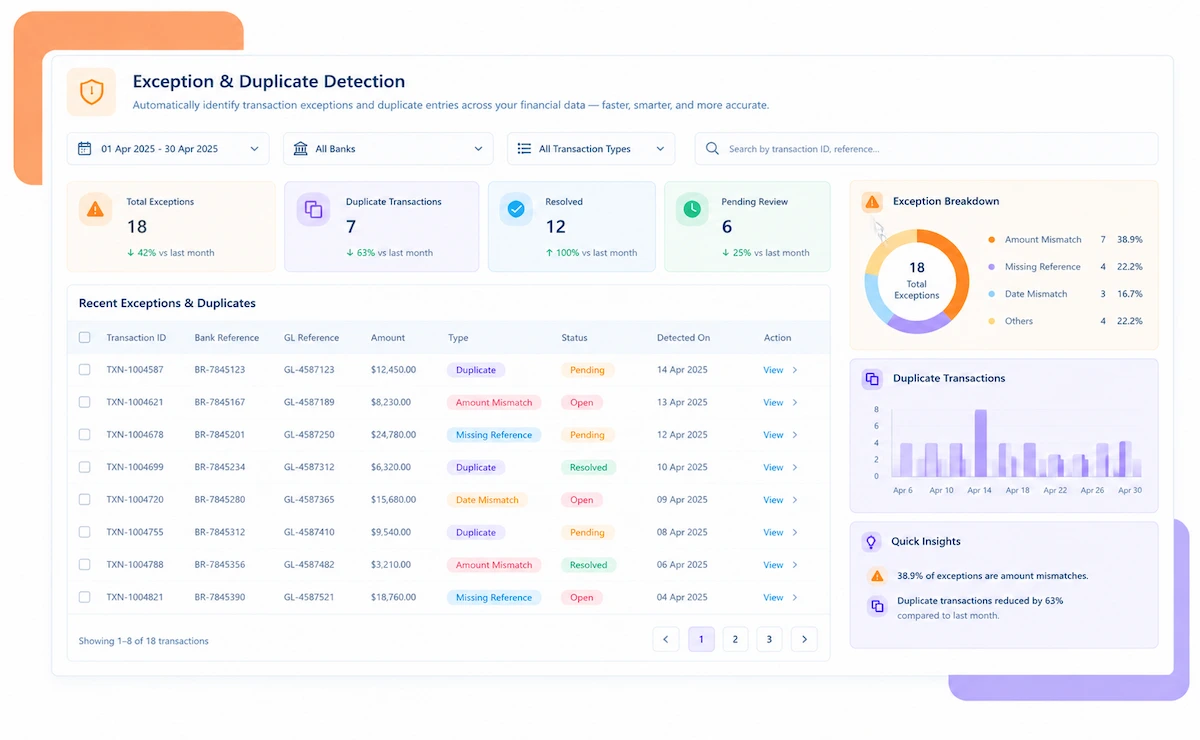
A Payment ID collision across regional entities is flagged instead of silently mismatched.

Settlement delays are flagged against the correct regional T+n window, not a blended assumption.
Fees that don't match the correct regional rate card are flagged automatically.
Every region reconciles in one system instead of separate spreadsheets per entity.
Adding a new PayU region doesn't require building a new reconciliation process from scratch.
Kosh AI connects directly with all major banks and ERPs, enabling real-time data sync for faster, more accurate reconciliations—no manual uploads, no delays.


PayU reconciliation software matches every transaction processed through any of PayU's regional entities, India, Latin America, Central and Eastern Europe, against its actual bank settlement, normalizing each region's own field names, report formats, and settlement timelines into one consistent reconciliation process. What makes this matter is that PayU operates less like a single global platform and more like several regional payment systems sharing a brand. A business expanding from one PayU region into another typically has to build a second reconciliation process from scratch, unless the software is designed to normalize across regions from the start. Kosh AI does that normalization automatically.

Here's what actually changes when PayU reconciliation moves from a separate process per region to one normalized reconciliation across all of them.
| What's Being Normalized | Normalized Cross-Region Reconciliation | Separate Process Per Region |
|---|---|---|
| Handling Multiple Regions | Every region's format normalized into one consistent reconciliation. | Each region is reconciled using its own separate process and spreadsheet. |
| Matching Payment IDs | IDs matched correctly within each entity, with cross-region collisions flagged. | Cross-region ID collisions can go unnoticed without entity-aware matching. |
| Settlement Timing | Each region's own T+n timeline is tracked and evaluated correctly. | One assumed timeline is often applied across regions with different actual windows. |
| Verifying Fees | Expected fees recalculated against the correct regional rate card. | Fees are usually accepted as reported without regional recalculation. |
| Expanding Into New Regions | A new PayU region is added into the same normalized reconciliation. | A new region typically means building a new reconciliation process. |
| Closing the Books | Every region reconciles in one system with a documented trail. | Each region often needs its own separate check before a consolidated close. |
Connect every PayU regional entity you operate with to Kosh AI and reconcile all of them through one consistent process.
Schedule a Quick DemoPayU operates as a shared brand across genuinely different regional systems. Reconciliation needs to account for that, not paper over it.

It's not only for businesses operating in every PayU region at once. Here's who tends to benefit most.
Each region's own format and timeline need normalizing into one consistent reconciliation.
A new region shouldn't require building a separate reconciliation process from scratch.
Unexplained gaps across regional settlement formats tend to delay month-end close every period.
Cross-region transaction volume needs consistent matching logic regardless of which entity processed it.
A small percentage of cross-region mismatches still adds up to real money at scale.
Recurring PayU charges across regions need to reconcile without extra manual tracking per entity.
No tool is a perfect fit for every business. Here's an honest look at what PayU reconciliation software gets right, and what's worth planning around before you adopt it.
PayU reconciliation software matches transactions across PayU's regional entities, India, LatAm, and Europe, normalizing each region's own settlement format into one consistent reconciliation. Kosh AI does this automatically.
PayU India, PayU LatAm, and PayU Europe each run their own settlement infrastructure with different field names, report structures, and settlement timelines, even though they share the same brand.
Kosh AI flags cross-region Payment ID collisions instead of silently mismatching them, since each regional entity generates its own IDs that can, in rare cases, overlap.
It pulls transaction and settlement data from every PayU regional entity you use, normalizes each region's format, and matches transactions against the correct regional timeline and bank deposit.
Yes, expected fees are recalculated using the correct regional rate card for each transaction, with mismatches flagged for review.
Yes, if you only use PayU in one region, Kosh AI reconciles that entity on its own. The cross-region normalization becomes relevant as you expand.
Yes, Kosh AI connects to PayU's regional entities and major banks, alongside ERPs like SAP, Oracle, NetSuite, and QuickBooks, pulling data from all of them automatically.

It gets flagged as an exception within the same reconciliation cycle, evaluated against the correct T+n window for its specific region, not a blended assumption.
Most businesses can have their primary region reconciling automatically within a few weeks. Businesses operating across several PayU regions typically take 2 to 3 months to fully configure.
Start with how many PayU regions you operate in, since that determines how much format normalization you actually need. From there, compare options on cross-region ID handling and regional timeline accuracy. Kosh AI is built around exactly that checklist, but it applies to any software you're comparing.

Book a demo and watch Kosh AI normalize your own PayU regions into one reconciliation.

Book a Demo