Match Medication Orders, Dispensing Records, and Billing Data Across Every System Automatically
Reconciling medication records isn't one comparison. It's several, spanning the order, the fill, the bill, and the shelf. Teams that need matching claims against EOBs and contracted rates usually turn to claims reconciliation tool alongside this.
Four steps that take a dispensed medication from order to a fully reconciled, audit-ready record.
What medication reconciliation needs to cover changes with facility type and patient volume. Running this alongside PSAO reconciliation software is common for finance teams that also handle reconciling pharmacy claims and remittances for PSAOs.
Keeping orders, dispensing, and billing aligned across high patient volume and frequent transitions of care.
Reconciling recurring medication orders against dispensing and billing for residents over extended stays.
Matching high fill volume against claims and inventory without a manual count at every shift change.
Confirming every dispensing event ties back to an active order and matches the shelf count.
Getting a consolidated medication list in front of clinical staff before they sign off at a transition.
Catching dispensed medications that never made it onto a claim before the revenue is lost.
Pulling together medication history from referring providers and prior pharmacy records into one view.
Re-checking active orders against dispensing records whenever a patient moves between units.
Confirming the discharge medication list matches what was actually dispensed during the stay.
Kosh AI extends the same approach to billing reconciliation software, built for matching what's billed against what's recorded across the rest of the business.
Every fill ties back to an order, so a discrepancy gets a cause instead of a shrug at month-end.
Clinical staff review one consolidated list instead of cross-referencing several source records by hand.
Dispensed medications that never reached a claim are surfaced before the window to bill closes.
Shelf counts stay checked against dispensing logs instead of being trued up only at a periodic count.
Order, dispensing, billing, and resolution records are already linked when a review asks for them.
A health system running this across every unit gets one view without a separate process per location.
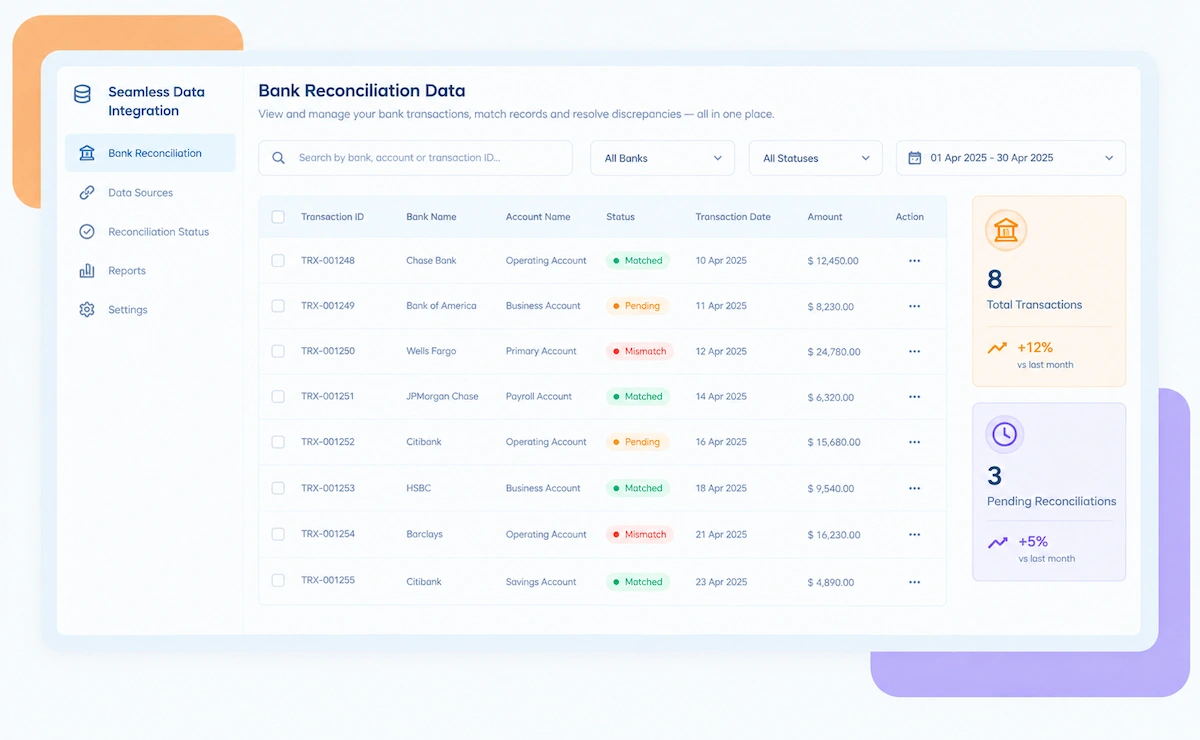
Kosh AI connects directly with all major banks and ERPs, enabling real-time data sync for faster, more accurate reconciliations—no manual uploads, no delays.


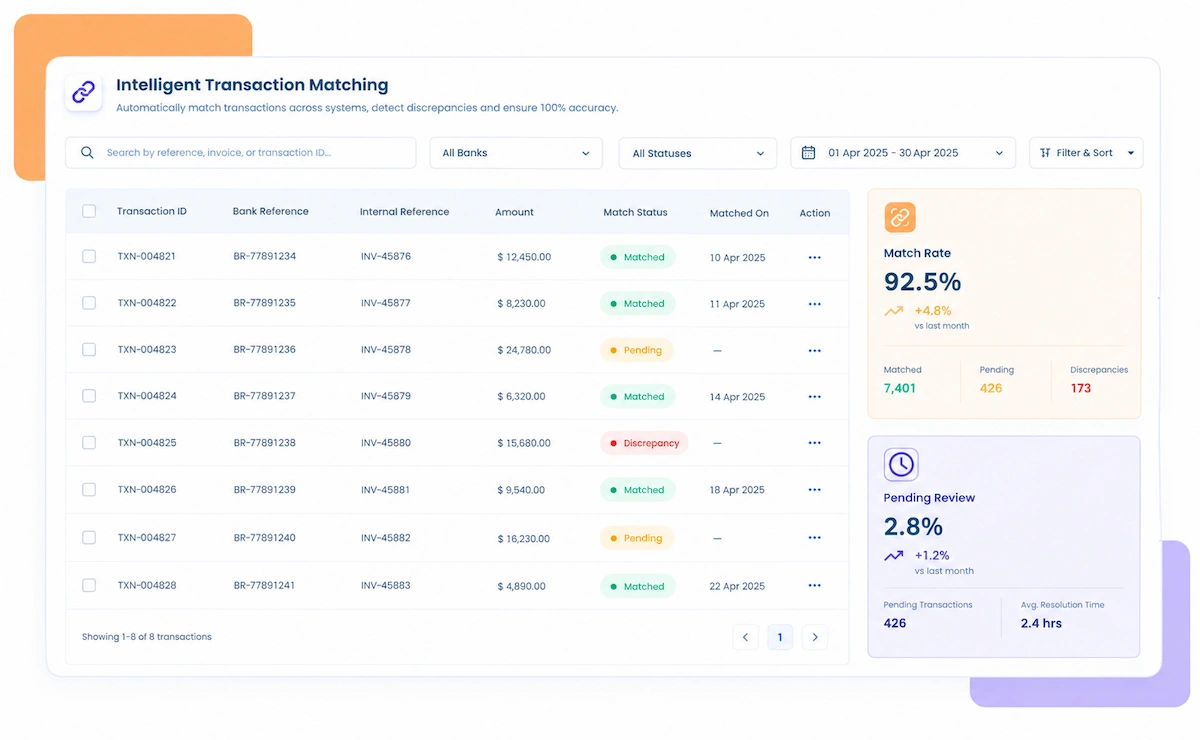
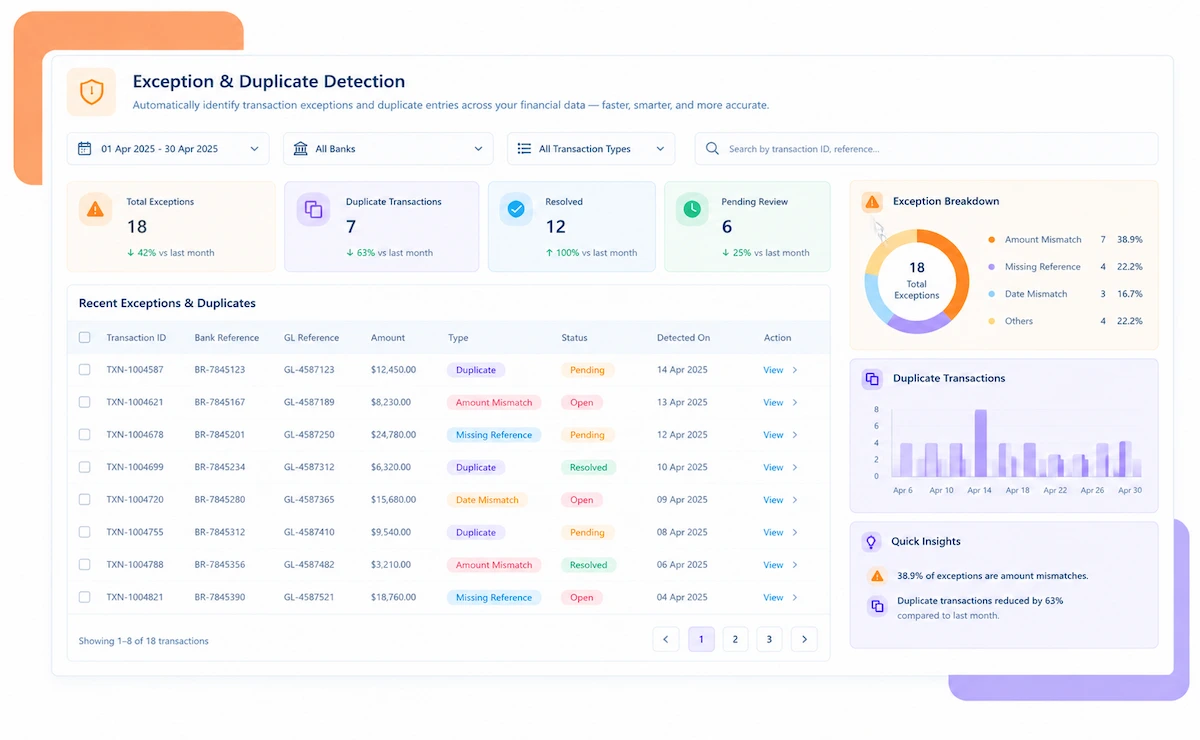
Spotting a real discrepancy across orders, dispensing, billing, and inventory takes more than a line-item comparison. Kosh AI understands which gaps are timing and which ones need a closer look. For running the same rigor across every unit in a larger health system, see how enterprise reconciliation software handles it end to end.
Learns the typical gap between an order and a fill, so a dispensing event with no matching order stands out immediately.
Flags dispensed medications that never made it onto a claim, before the billing window closes.
Distinguishes a routine timing lag between a fill and a shelf count update from a genuine inventory variance.
Pulls conflicting entries from multiple source records into one view, so clinical staff review a single list, not several.
Medication reconciliation software checks that the record of a medication order, the record of it being dispensed, the claim billed for it, and the inventory drawn down to fill it all agree with each other. When every source lines up, the record is reconciled. When one doesn't, the discrepancy is flagged with enough context for the right team, clinical or administrative, to resolve it.

Done manually, this usually means pharmacy staff and case managers cross-referencing the EHR, the pharmacy dispensing system, and a payer portal by hand, often at the exact moments, admission, transfer, discharge, when they have the least time to spare. A missed match on one patient is easy to catch. Across a full unit's census and a full day's dispensing volume, those small gaps compound into clinical risk, lost billing revenue, and inventory that never quite ties out.
Kosh AI's medication reconciliation software connects orders, dispensing records, billing data, and inventory logs automatically, and routes every discrepancy to the team best placed to resolve it. It consolidates medication lists for clinical staff to review and sign off on; it does not make clinical decisions on its own.

Cross-referencing orders, dispensing, and billing by hand can work on a quiet day. See what changes once reconciliation runs automatically. Many teams pair this with account reconciliation software, which focuses on matching GL account balances against supporting records every close.
| Feature | Automated Medication Reconciliation | Manual Medication Reconciliation |
|---|---|---|
| Order-to-Dispensing Matching | Matched automatically by patient, drug, and order ID. | Checked by hand, often only when something looks obviously wrong. |
| Billing Accuracy | Dispensed quantities checked against every claim line. | Unbilled dispensing events can go unnoticed until a revenue review. |
| Inventory Drawdown | Checked against the dispensing log continuously. | Trued up only at a periodic physical count. |
| Medication List Consolidation | Sources pulled into one view automatically at each transition. | Cross-referenced manually across separate screens and records. |
| Discrepancy Routing | Sent to the right team automatically, with context attached. | Identified case by case, often after the fact. |
| Audit Trail | Assembled continuously as records are matched. | Reconstructed from multiple systems before a compliance review. |

A dispensed medication generates a record in at least three places: the order in the EHR, the fill in the pharmacy system, and the claim sent to the payer. Add inventory, and it's four. Keeping all of them in agreement by hand works for a small facility with a quiet census, but it breaks down fast once patient volume, unit count, or formulary complexity climbs.
The cost of a missed reconciliation isn't hypothetical. An order that was discontinued but still dispensed is a clinical risk waiting to be caught. A fill that never made it onto a claim is revenue that quietly disappears. A shelf count that drifts from the dispensing log eventually becomes a controlled-substance question nobody wants to answer after the fact. None of these show up clearly until someone goes looking, and by then the window to catch them cheaply has usually closed.
Kosh AI's medication reconciliation software keeps orders, dispensing, billing, and inventory connected automatically, so a mismatch surfaces the moment it happens and reaches the team, clinical or administrative, that can actually resolve it. It consolidates the information clinical staff need to make their own medication decisions; it does not replace their clinical judgment.

Medication reconciliation gets noticeably harder in a few predictable scenarios.
More admissions, transfers, and discharges mean more moments where a medication list needs to be consolidated fast.
An EHR, a pharmacy dispensing system, and a payer portal that don't talk to each other leave the matching to staff.
These are exactly the drawdowns where an inventory variance carries the most scrutiny and the least tolerance for drift.
A health system running the same reconciliation process across several units needs one view, not one process per location.
A few steps take medication reconciliation from a manual cross-reference to an automated, audit-ready process.
Bring a recent discharge where the medication list took longer than it should have to pull together. We'll show you how Kosh AI would have consolidated it automatically.
Book a Demo